Question 4
A product field has proportional spatial snapshots. Consider the two-mode heat solution on , , For any two positions and times define
Tasks
Prove that a product field has . Conversely, if every such determinant vanishes and somewhere, construct factors representing everywhere.
Verify the PDE and homogeneous Dirichlet endpoints for the displayed sum. Compute at and decide whether the sum is a single product.
Find every interior spatial zero of , the time at which it leaves the interior, and the sign of the field after that time.
Sketch the normalized snapshots at , and . Explain why division by a nonzero time factor cannot make a nonseparable field separable.
Show solutionHide solution
Question 4 – Solution
Strategy. Test separation with an invariant determinant, then interpret the changing spatial shape.
Step 1: Establish an exact product test. For a product, both terms of equal . Conversely, use the nonzero anchor to write . Hence gives a product everywhere, including zeros. The nonzero-anchor restriction excludes only the identically zero field, which is already a trivial product.
Step 2: Verify the solution and reject one-product form. Each term has time derivative equal to its second spatial derivative; the sum solves the PDE and vanishes at . At the stated points, Thus superposition preserves the linear PDE but does not preserve the class of single products. The two spatial modes decay at different rates.
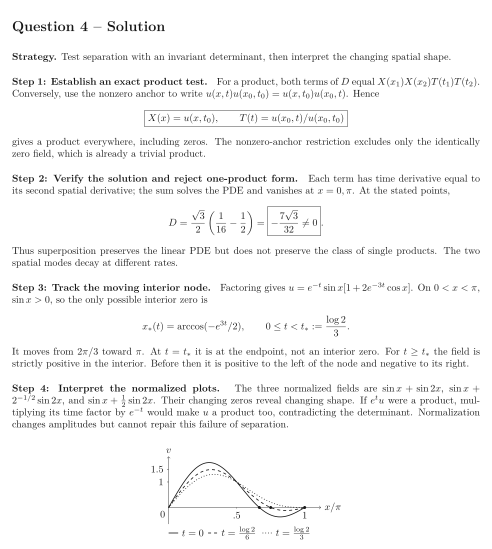
Step 3: Track the moving interior node. Factoring gives . On , , so the only possible interior zero is It moves from toward . At it is at the endpoint, not an interior zero. For the field is strictly positive in the interior. Before then it is positive to the left of the node and negative to its right.
Step 4: Interpret the normalized plots. The three normalized fields are , , and . Their changing zeros reveal changing shape. If were a product, multiplying its time factor by would make a product too, contradicting the determinant. Normalization changes amplitudes but cannot repair this failure of separation.
See the diagram in the original worksheet below.