Question 3
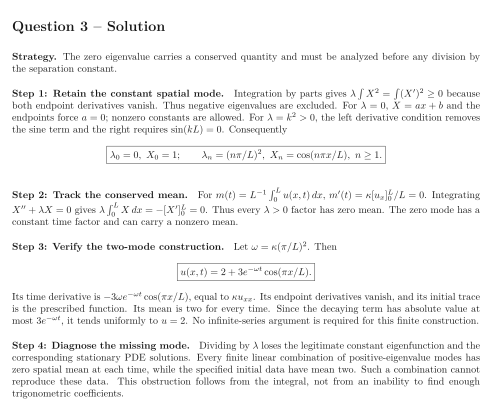
For on , , take and insulated endpoints . Use and . All fields are smooth enough for the stated derivatives and integrals.
Tasks
Solve the spatial eigenvalue problem, including , and exclude by an integral identity.
Show directly from the PDE that the spatial mean is constant in time. Prove that each positive-eigenvalue spatial factor has zero mean, without evaluating its trigonometric integral.
Construct a finite separated-mode sum satisfying . Verify the PDE, both endpoints and the initial data, and identify the limiting field as .
Explain precisely what is lost if one divides the eigenvalue calculation by and discards the zero case. Can any finite sum of positive-eigenvalue modes reproduce these initial data?
Show solutionHide solution
Question 3 – Solution
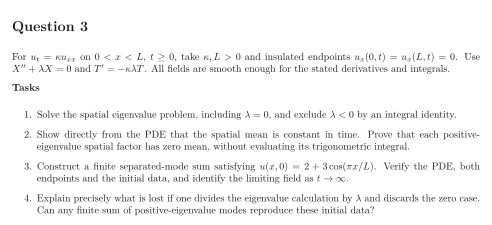
Strategy. The zero eigenvalue carries a conserved quantity and must be analyzed before any division by the separation constant.
Step 1: Retain the constant spatial mode. Integration by parts gives because both endpoint derivatives vanish. Thus negative eigenvalues are excluded. For , and the endpoints force ; nonzero constants are allowed. For , the left derivative condition removes the sine term and the right requires . Consequently
Step 2: Track the conserved mean. For , . Integrating gives . Thus every factor has zero mean. The zero mode has a constant time factor and can carry a nonzero mean.
Step 3: Verify the two-mode construction. Let . Then Its time derivative is , equal to . Its endpoint derivatives vanish, and its initial trace is the prescribed function. Its mean is two for every time. Since the decaying term has absolute value at most , it tends uniformly to . No infinite-series argument is required for this finite construction.
Step 4: Diagnose the missing mode. Dividing by loses the legitimate constant eigenfunction and the corresponding stationary PDE solutions. Every finite linear combination of positive-eigenvalue modes has zero spatial mean at each time, while the specified initial data have mean two. Such a combination cannot reproduce these data. This obstruction follows from the integral, not from an inability to find enough trigonometric coefficients.