Question 5
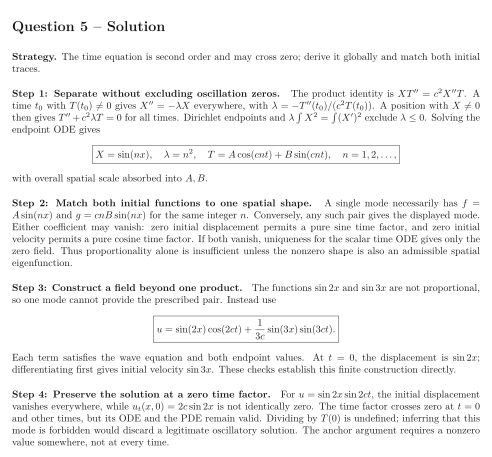
For on , , with and , seek a nonzero product with both factors . Use the convention .
Tasks
Derive the two factor equations using nonzero anchor values instead of assuming has no zeros. Determine the allowed spatial factors and time factors.
Prove the precise restriction a single product places on its two initial functions and . Include the cases where one of these functions vanishes identically.
Determine whether can come from one separated mode. Construct a sum of two modes that satisfies both initial functions and verify it directly.
Use to explain why a zero-displacement snapshot need not mean zero solution or zero velocity. Explain the error in dividing by at that time.
Show solutionHide solution
Question 5 – Solution
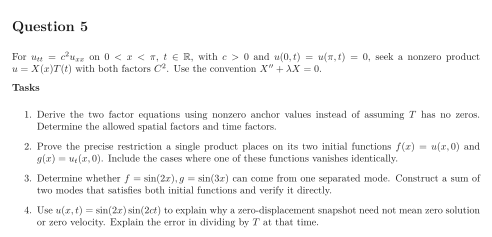
Strategy. The time equation is second order and may cross zero; derive it globally and match both initial traces.
Step 1: Separate without excluding oscillation zeros. The product identity is . A time with gives everywhere, with . A position with then gives for all times. Dirichlet endpoints and exclude . Solving the endpoint ODE gives with overall spatial scale absorbed into .
Step 2: Match both initial functions to one spatial shape. A single mode necessarily has and for the same integer . Conversely, any such pair gives the displayed mode. Either coefficient may vanish: zero initial displacement permits a pure sine time factor, and zero initial velocity permits a pure cosine time factor. If both vanish, uniqueness for the scalar time ODE gives only the zero field. Thus proportionality alone is insufficient unless the nonzero shape is also an admissible spatial eigenfunction.
Step 3: Construct a field beyond one product. The functions and are not proportional, so one mode cannot provide the prescribed pair. Instead use Each term satisfies the wave equation and both endpoint values. At , the displacement is ; differentiating first gives initial velocity . These checks establish this finite construction directly.
Step 4: Preserve the solution at a zero time factor. For , the initial displacement vanishes everywhere, while is not identically zero. The time factor crosses zero at and other times, but its ODE and the PDE remain valid. Dividing by is undefined; inferring that this mode is forbidden would discard a legitimate oscillatory solution. The anchor argument requires a nonzero value somewhere, not at every time.