Question 4
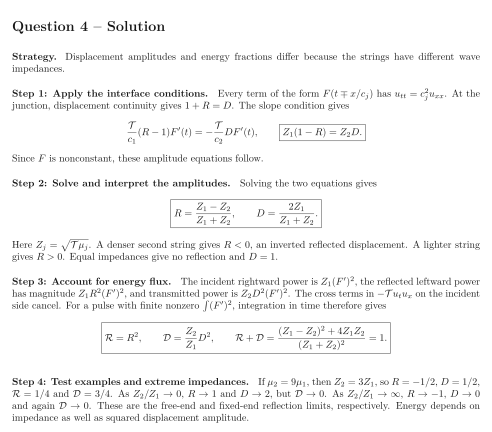
Two semi-infinite strings meet at , share tension and have densities . Set and . The massless junction has continuous displacement and continuous transverse force . For a smooth incident pulse with , write
Tasks
Verify each traveling term solves its local wave equation and derive the two junction equations for .
Solve for and classify the sign of the reflected displacement when the second string is denser or lighter.
Using rightward power , derive the reflected and transmitted energy fractions and prove their sum is one.
Evaluate the case . Analyze the limits and , and explain why a transmitted displacement amplitude above one need not violate energy conservation.
Show solutionHide solution
Question 4 – Solution
Strategy. Displacement amplitudes and energy fractions differ because the strings have different wave impedances.
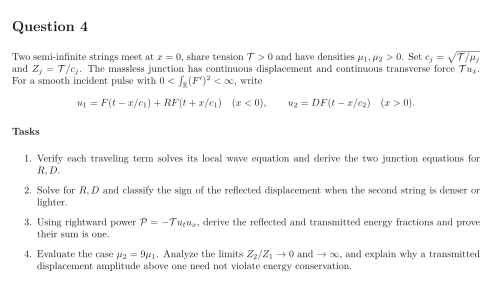
Step 1: Apply the interface conditions. Every term of the form has . At the junction, displacement continuity gives . The slope condition gives Since is nonconstant, these amplitude equations follow.
Step 2: Solve and interpret the amplitudes. Solving the two equations gives Here . A denser second string gives , an inverted reflected displacement. A lighter string gives . Equal impedances give no reflection and .
Step 3: Account for energy flux. The incident rightward power is , the reflected leftward power has magnitude , and transmitted power is . The cross terms in on the incident side cancel. For a pulse with finite nonzero , integration in time therefore gives
Step 4: Test examples and extreme impedances. If , then , so , , and . As , and , but . As , , and again . These are the free-end and fixed-end reflection limits, respectively. Energy depends on impedance as well as squared displacement amplitude.