Question 5
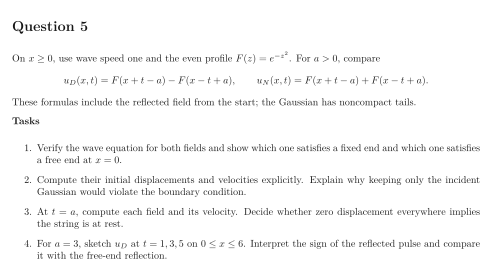
On , use wave speed one and the even profile . For , compare These formulas include the reflected field from the start; the Gaussian has noncompact tails.
Tasks
Verify the wave equation for both fields and show which one satisfies a fixed end and which one satisfies a free end at .
Compute their initial displacements and velocities explicitly. Explain why keeping only the incident Gaussian would violate the boundary condition.
At , compute each field and its velocity. Decide whether zero displacement everywhere implies the string is at rest.
For , sketch at on . Interpret the sign of the reflected pulse and compare it with the free-end reflection.
Show solutionHide solution
Question 5 – Solution
Strategy. An odd or even spatial reflection enforces the corresponding boundary condition.
Step 1: Verify the two boundary models. Each translated profile solves . Since is even and is odd, Thus satisfies the fixed-end condition and the free-end condition.
Step 2: Recover the actual initial data. Differentiating the time arguments carefully gives where . The incident term alone generally has neither zero boundary displacement nor zero boundary slope. Its reflected partner supplies the exact cancellation; small Gaussian tails are not identically zero.
Step 3: Inspect the collision instant. At , the two profile arguments both equal . Therefore The fixed-end string has zero displacement but nonzero velocity for : it is not at rest. The free-end field has a doubled displacement profile at that instant and zero instantaneous velocity. Displacement and velocity must both be known to specify the state.
Step 4: Interpret the reflected sign. For , the incoming peak at is near . At the fixed-end displacement is exactly zero everywhere. At the reflected pulse is near with opposite sign. Indeed . A fixed end reverses displacement upon reflection; a free end preserves its sign. The plotted zero snapshot is an exact cancellation, not disappearance of the motion or its energy.
See the diagram in the original worksheet below.
