Question 8
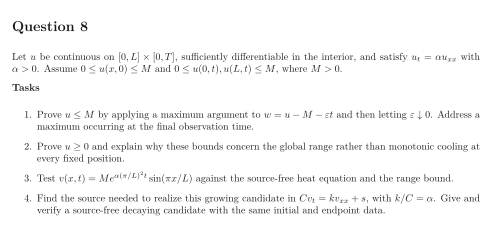
Let be continuous on , sufficiently differentiable in the interior, and satisfy with . Assume and , where .
Tasks
Prove by applying a maximum argument to and then letting . Address a maximum occurring at the final observation time.
Prove and explain why these bounds concern the global range rather than monotonic cooling at every fixed position.
Test against the source-free heat equation and the range bound.
Find the source needed to realize this growing candidate in , with . Give and verify a source-free decaying candidate with the same initial and endpoint data.
Show solutionHide solution
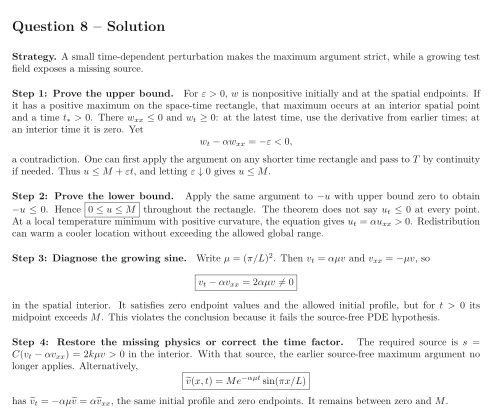
Question 8 – Solution
Strategy. A small time-dependent perturbation makes the maximum argument strict, while a growing test field exposes a missing source.
Step 1: Prove the upper bound. For , is nonpositive initially and at the spatial endpoints. If it has a positive maximum on the space-time rectangle, that maximum occurs at an interior spatial point and a time . There and : at the latest time, use the derivative from earlier times; at an interior time it is zero. Yet a contradiction. One can first apply the argument on any shorter time rectangle and pass to by continuity if needed. Thus , and letting gives .
Step 2: Prove the lower bound. Apply the same argument to with upper bound zero to obtain . Hence throughout the rectangle. The theorem does not say at every point. At a local temperature minimum with positive curvature, the equation gives . Redistribution can warm a cooler location without exceeding the allowed global range.
Step 3: Diagnose the growing sine. Write . Then and , so in the spatial interior. It satisfies zero endpoint values and the allowed initial profile, but for its midpoint exceeds . This violates the conclusion because it fails the source-free PDE hypothesis.
Step 4: Restore the missing physics or correct the time factor. The required source is in the interior. With that source, the earlier source-free maximum argument no longer applies. Alternatively, has , the same initial profile and zero endpoints. It remains between zero and .