Question 7
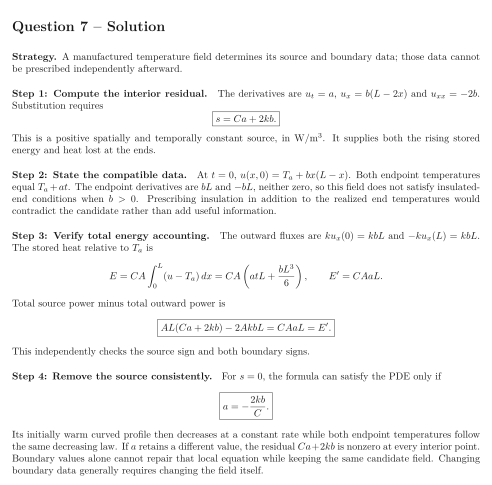
A constant-area rod with constant is prescribed the candidate field The model permits a volumetric source and obeys . Its lateral surface is insulated; end conditions must be determined consistently.
Tasks
Determine the unique source field that makes the candidate satisfy the equation.
State the initial and Dirichlet boundary data realized by the candidate. Decide whether it also satisfies insulated-end conditions.
Compute both outward end heat fluxes and verify the integrated energy balance, using cross-sectional area .
Suppose the source is removed while the same formula is retained but is allowed to be real. Find the required and explain why changing only the boundary values cannot fix a nonzero interior residual.
Show solutionHide solution
Question 7 – Solution
Strategy. A manufactured temperature field determines its source and boundary data; those data cannot be prescribed independently afterward.
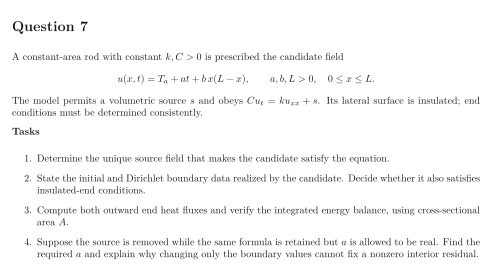
Step 1: Compute the interior residual. The derivatives are , and . Substitution requires This is a positive spatially and temporally constant source, in . It supplies both the rising stored energy and heat lost at the ends.
Step 2: State the compatible data. At , . Both endpoint temperatures equal . The endpoint derivatives are and , neither zero, so this field does not satisfy insulated-end conditions when . Prescribing insulation in addition to the realized end temperatures would contradict the candidate rather than add useful information.
Step 3: Verify total energy accounting. The outward fluxes are and . The stored heat relative to is Total source power minus total outward power is This independently checks the source sign and both boundary signs.
Step 4: Remove the source consistently. For , the formula can satisfy the PDE only if Its initially warm curved profile then decreases at a constant rate while both endpoint temperatures follow the same decreasing law. If retains a different value, the residual is nonzero at every interior point. Boundary values alone cannot repair that local equation while keeping the same candidate field. Changing boundary data generally requires changing the field itself.