Question 9
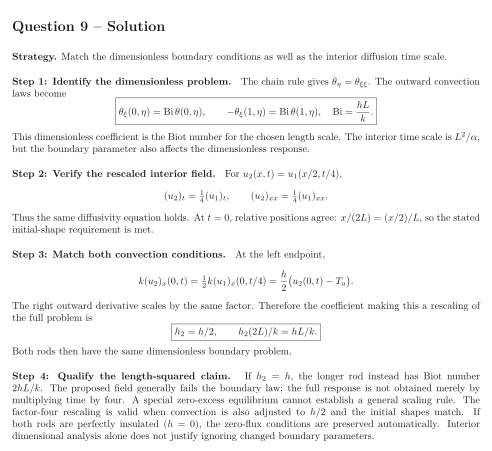
Two homogeneous rods have lengths and , the same , insulated sides and no sources. At both ends each rod exchanges heat with the same ambient by an outward convection law. The first rod has coefficient . The two initial profiles have the same shape as functions of relative position. Set and choose a nonzero temperature scale .
Tasks
Nondimensionalize the first problem using , and . Identify the dimensionless boundary parameter.
Verify the PDE and initial shape for the proposed rescaling on the longer rod.
Derive exactly which convection coefficient makes this rescaling satisfy both boundary laws.
Assess the claim that doubling length always quadruples every thermal response time when the same is used. State when the proposed scaling is valid, including the perfectly insulated case.
Show solutionHide solution
Question 9 – Solution
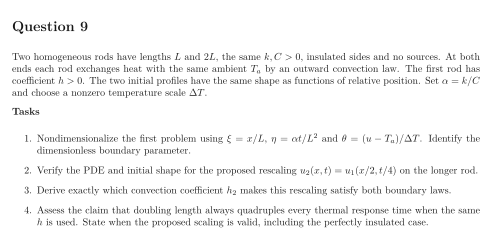
Strategy. Match the dimensionless boundary conditions as well as the interior diffusion time scale.
Step 1: Identify the dimensionless problem. The chain rule gives . The outward convection laws become This dimensionless coefficient is the Biot number for the chosen length scale. The interior time scale is , but the boundary parameter also affects the dimensionless response.
Step 2: Verify the rescaled interior field. For , Thus the same diffusivity equation holds. At , relative positions agree: , so the stated initial-shape requirement is met.
Step 3: Match both convection conditions. At the left endpoint, The right outward derivative scales by the same factor. Therefore the coefficient making this a rescaling of the full problem is Both rods then have the same dimensionless boundary problem.
Step 4: Qualify the length-squared claim. If , the longer rod instead has Biot number . The proposed field generally fails the boundary law; the full response is not obtained merely by multiplying time by four. A special zero-excess equilibrium cannot establish a general scaling rule. The factor-four rescaling is valid when convection is also adjusted to and the initial shapes match. If both rods are perfectly insulated (), the zero-flux conditions are preserved automatically. Interior dimensional analysis alone does not justify ignoring changed boundary parameters.