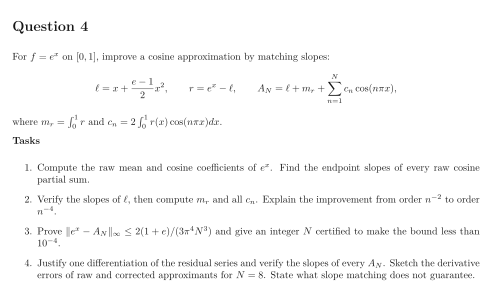
Question 4
For on , improve a cosine approximation by matching slopes: where and .
Tasks
Compute the raw mean and cosine coefficients of . Find the endpoint slopes of every raw cosine partial sum.
Verify the slopes of , then compute and all . Explain the improvement from order to order .
Prove and give an integer certified to make the bound less than .
Justify one differentiation of the residual series and verify the slopes of every . Sketch the derivative errors of raw and corrected approximants for . State what slope matching does not guarantee.
Show solutionHide solution
Question 4 – Solution
Strategy. Remove the endpoint-slope contribution while retaining the residual’s generally nonzero mean.
Step 1: Compute the raw data. For , direct integration gives Every raw finite cosine sum has zero endpoint derivatives, disagreeing with and .
Step 2: Cancel the slope contribution. The derivative matches both target endpoint slopes. Two integrations by parts give its positive-frequency coefficient ; the constant second derivative has zero cosine integral. Subtracting yields The residual has zero endpoint derivatives, so the leading slope term cancels and fourth-power decay remains. Its mean must still be included.
Step 3: Certify the function error. The bound gives uniform absolute convergence. The continuous piecewise smooth even extension identifies the sum with . Consequently The choice makes this bound less than .
Step 4: Verify the derivative behavior. Derivative coefficients are bounded by a constant times , so that series converges uniformly. Together with convergence at one point, this justifies differentiation. Every residual partial sum has zero endpoint slopes; adding gives exactly. Slope matching does not force exact endpoint values at finite ; those are controlled by the function-error bound and become exact in the limit.
See the diagram in the original worksheet below.
