Question 5
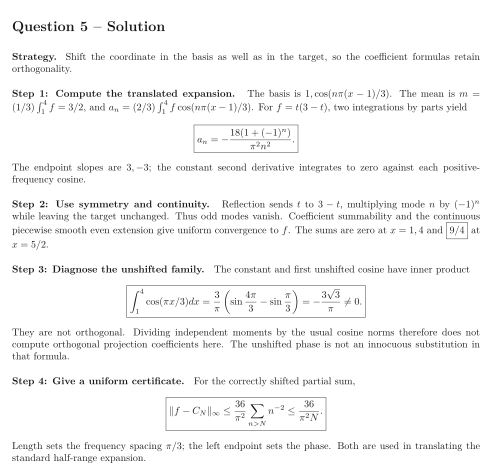
On the shifted interval , expand using a cosine basis adapted to its left endpoint. Put .
Tasks
State the correct shifted basis and coefficient normalization. Compute the mean and all positive-frequency coefficients.
Use reflection about to explain the missing odd modes. Determine the series sum at the endpoints and midpoint.
Someone uses with the usual orthogonal coefficient formula. Compute the inner product of the first two listed functions and diagnose the failure.
Derive a uniform truncation bound for the correct series. Explain why interval length alone does not specify the phase origin required by standard cosine orthogonality.
Show solutionHide solution
Question 5 – Solution
Strategy. Shift the coordinate in the basis as well as in the target, so the coefficient formulas retain orthogonality.
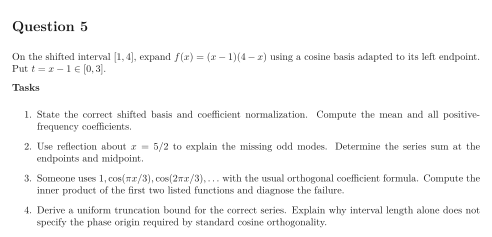
Step 1: Compute the translated expansion. The basis is . The mean is , and . For , two integrations by parts yield The endpoint slopes are ; the constant second derivative integrates to zero against each positive-frequency cosine.
Step 2: Use symmetry and continuity. Reflection sends to , multiplying mode by while leaving the target unchanged. Thus odd modes vanish. Coefficient summability and the continuous piecewise smooth even extension give uniform convergence to . The sums are zero at and at .
Step 3: Diagnose the unshifted family. The constant and first unshifted cosine have inner product They are not orthogonal. Dividing independent moments by the usual cosine norms therefore does not compute orthogonal projection coefficients here. The unshifted phase is not an innocuous substitution in that formula.
Step 4: Give a uniform certificate. For the correctly shifted partial sum, Length sets the frequency spacing ; the left endpoint sets the phase. Both are used in translating the standard half-range expansion.