Question 3
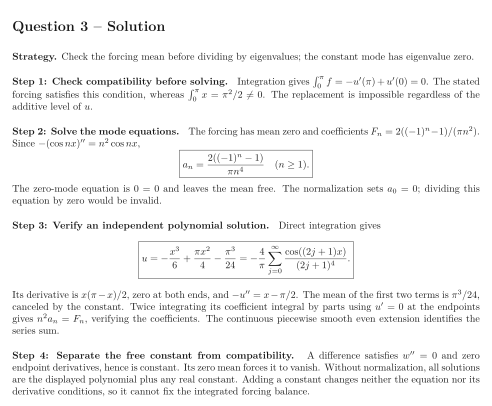
Consider the normalized Neumann problem Use the convention .
Tasks
Derive the integral compatibility condition for a general forcing with these derivative conditions. Explain why replacing the forcing by makes the problem impossible.
Find the cosine coefficients of the stated forcing. Explain how the zero mode differs from every positive-frequency mode when solving for .
Solve in closed form and as a cosine series. Verify the equation, both derivative conditions and the mean.
Prove uniqueness with the normalization, and state the full family without it. Explain why adding a constant cannot repair an incompatible forcing.
Show solutionHide solution
Question 3 – Solution
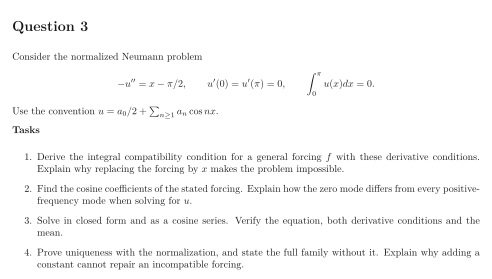
Strategy. Check the forcing mean before dividing by eigenvalues; the constant mode has eigenvalue zero.
Step 1: Check compatibility before solving. Integration gives . The stated forcing satisfies this condition, whereas . The replacement is impossible regardless of the additive level of .
Step 2: Solve the mode equations. The forcing has mean zero and coefficients . Since , The zero-mode equation is and leaves the mean free. The normalization sets ; dividing this equation by zero would be invalid.
Step 3: Verify an independent polynomial solution. Direct integration gives Its derivative is , zero at both ends, and . The mean of the first two terms is , canceled by the constant. Twice integrating its coefficient integral by parts using at the endpoints gives , verifying the coefficients. The continuous piecewise smooth even extension identifies the series sum.
Step 4: Separate the free constant from compatibility. A difference satisfies and zero endpoint derivatives, hence is constant. Its zero mean forces it to vanish. Without normalization, all solutions are the displayed polynomial plus any real constant. Adding a constant changes neither the equation nor its derivative conditions, so it cannot fix the integrated forcing balance.