Question 6
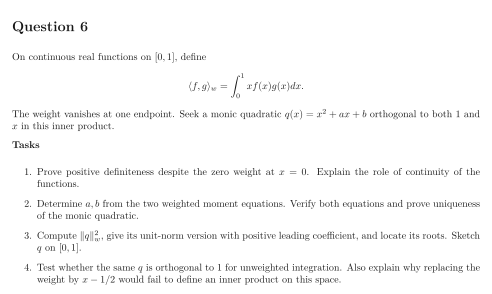
On continuous real functions on , define The weight vanishes at one endpoint. Seek a monic quadratic orthogonal to both and in this inner product.
Tasks
Prove positive definiteness despite the zero weight at . Explain the role of continuity of the functions.
Determine from the two weighted moment equations. Verify both equations and prove uniqueness of the monic quadratic.
Compute , give its unit-norm version with positive leading coefficient, and locate its roots. Sketch on .
Test whether the same is orthogonal to for unweighted integration. Also explain why replacing the weight by would fail to define an inner product on this space.
Show solutionHide solution
Question 6 – Solution
Strategy. Include the weight in every moment, and distinguish an isolated zero of a nonnegative weight from a sign-changing weight.
Step 1: Establish positive definiteness. Symmetry and bilinearity follow from integration, and . If a continuous is not identically zero, continuity supplies an interval of positive length inside on which , even if the first known nonzero value is at zero. The weighted integral is then positive. Thus zero weighted norm forces everywhere.
Step 2: Solve the weighted moment equations. The two conditions are Their coefficient determinant is , so the solution is unique: Substitution gives and .
Step 3: Normalize and locate the sign changes. Expansion and integration give Thus the unit-norm version is . The roots are , both strictly inside . The quadratic is positive outside these roots and negative between them.
Step 4: Check two changes of weight. Without the weight, . Orthogonality therefore changes with the weight. For the proposed signed weight, the nonzero constant function one would have squared “norm” . This violates positive definiteness, so that bilinear form is not an inner product on the stated space.
See the diagram in the original worksheet below.
