Question 5
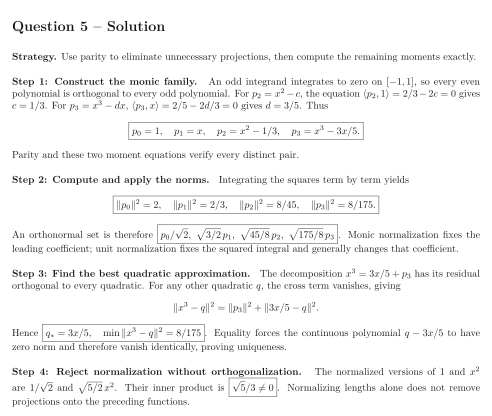
Use . Construct monic orthogonal polynomials from ; monic means the leading coefficient is one.
Tasks
Explain which inner products vanish by parity. Starting with and , find monic so that all four polynomials are mutually orthogonal.
Compute their squared norms exactly and turn them into an orthonormal set. Distinguish monic normalization from unit-norm normalization.
Find the unique quadratic-or-lower polynomial minimizing . Give the exact minimum error and justify uniqueness.
A proposed shortcut merely divides each monomial by its norm. Give an explicit inner product showing why this does not produce an orthogonal family.
Show solutionHide solution
Question 5 – Solution
Strategy. Use parity to eliminate unnecessary projections, then compute the remaining moments exactly.
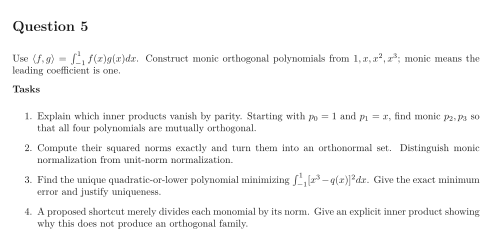
Step 1: Construct the monic family. An odd integrand integrates to zero on , so every even polynomial is orthogonal to every odd polynomial. For , the equation gives . For , gives . Thus Parity and these two moment equations verify every distinct pair.
Step 2: Compute and apply the norms. Integrating the squares term by term yields An orthonormal set is therefore . Monic normalization fixes the leading coefficient; unit normalization fixes the squared integral and generally changes that coefficient.
Step 3: Find the best quadratic approximation. The decomposition has its residual orthogonal to every quadratic. For any other quadratic , the cross term vanishes, giving Hence . Equality forces the continuous polynomial to have zero norm and therefore vanish identically, proving uniqueness.
Step 4: Reject normalization without orthogonalization. The normalized versions of and are and . Their inner product is . Normalizing lengths alone does not remove projections onto the preceding functions.