Question 7
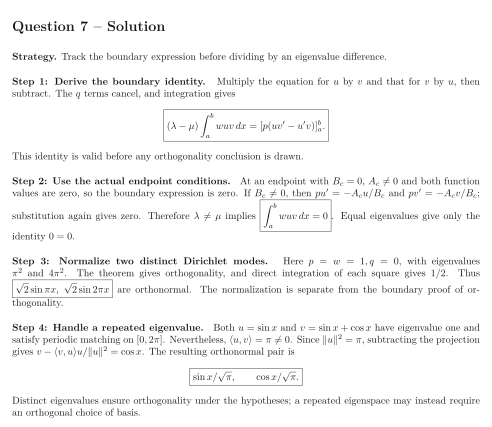
Let be positive, let be continuous with , and let be nonzero real eigenfunctions: At each endpoint , both satisfy the same condition , with real .
Tasks
Derive an identity relating to endpoint terms by multiplying and subtracting the differential equations.
Prove the endpoint terms vanish for all the stated boundary conditions, including . Deduce weighted orthogonality when .
Apply the result to and on with zero endpoint values. Give an orthonormal pair.
Explain why equal eigenvalues do not force orthogonality. On with periodic value-and-slope matching, use and as a counterexample, then orthogonalize and normalize this pair.
Show solutionHide solution
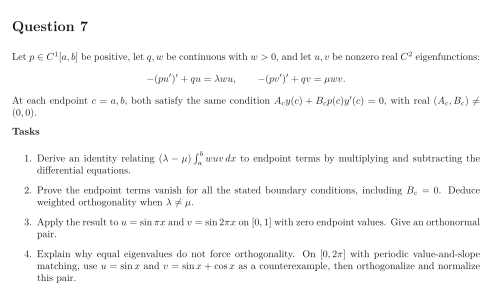
Question 7 – Solution
Strategy. Track the boundary expression before dividing by an eigenvalue difference.
Step 1: Derive the boundary identity. Multiply the equation for by and that for by , then subtract. The terms cancel, and integration gives This identity is valid before any orthogonality conclusion is drawn.
Step 2: Use the actual endpoint conditions. At an endpoint with , and both function values are zero, so the boundary expression is zero. If , then and ; substitution again gives zero. Therefore implies . Equal eigenvalues give only the identity .
Step 3: Normalize two distinct Dirichlet modes. Here , with eigenvalues and . The theorem gives orthogonality, and direct integration of each square gives . Thus are orthonormal. The normalization is separate from the boundary proof of orthogonality.
Step 4: Handle a repeated eigenvalue. Both and have eigenvalue one and satisfy periodic matching on . Nevertheless, . Since , subtracting the projection gives . The resulting orthonormal pair is Distinct eigenvalues ensure orthogonality under the hypotheses; a repeated eigenspace may instead require an orthogonal choice of basis.