Question 6
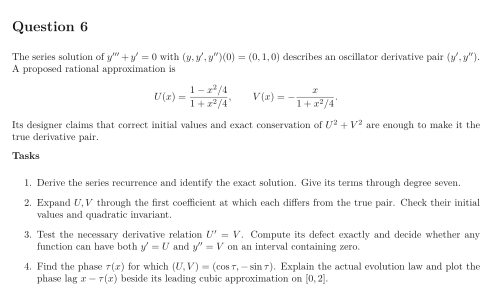
The series solution of with describes an oscillator derivative pair . A proposed rational approximation is Its designer claims that correct initial values and exact conservation of are enough to make it the true derivative pair.
Tasks
Derive the series recurrence and identify the exact solution. Give its terms through degree seven.
Expand through the first coefficient at which each differs from the true pair. Check their initial values and quadratic invariant.
Test the necessary derivative relation . Compute its defect exactly and decide whether any function can have both and on an interval containing zero.
Find the phase for which . Explain the actual evolution law and plot the phase lag beside its leading cubic approximation on .
Show solutionHide solution
Question 6 – Solution
Strategy. Test derivative compatibility in addition to an invariant and a few Taylor coefficients.
Step 1: Solve the series IVP. Coefficient matching gives . The data give the entire series The true pair is .
Step 2: Check local accuracy and the invariant. Near zero, The correct coefficients are and , respectively. Nevertheless , and direct squaring gives exactly.
Step 3: Expose the derivative defect. Writing , we obtain This is nonzero for . If , differentiation forces , so no such function has both proposed derivatives on a nontrivial interval containing zero. Conservation alone does not enforce the differential equation.
Step 4: Identify the altered clock. The half-angle identities give and . Thus , : the pair traverses the correct circle with a different speed. The phase lag is and is positive for because its derivative is .
See the diagram in the original worksheet below.
