Question 5
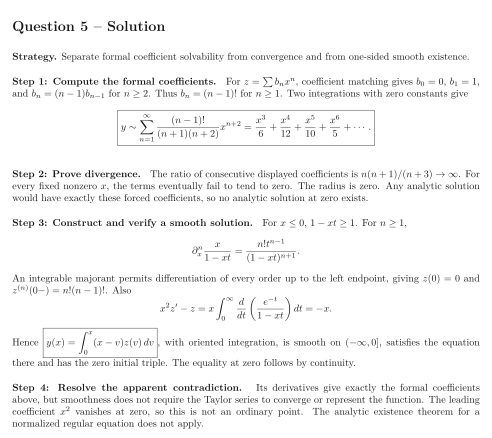
A formal power series is an algebraic coefficient expansion without an assumed positive radius of convergence. Investigate For a possible one-sided smooth solution, you may use
Tasks
Put and derive its formal coefficient recurrence. Find the first four nonzero terms of the formal series for .
Prove that the formal series for has radius zero. Deduce whether an analytic solution at zero can satisfy the equation and data.
Verify that the given integral defines a smooth function from the left at zero and satisfies . Recover a one-sided smooth solution with the required initial data.
Explain how this smooth solution can have the divergent formal series as its Taylor series. Identify the hypothesis that prevents application of the ordinary-point analytic existence theorem at zero.
Show solutionHide solution
Question 5 – Solution
Strategy. Separate formal coefficient solvability from convergence and from one-sided smooth existence.
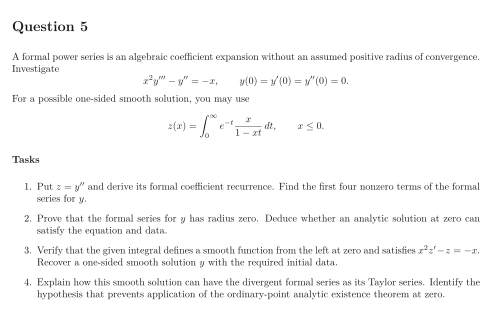
Step 1: Compute the formal coefficients. For , coefficient matching gives , , and for . Thus for . Two integrations with zero constants give
Step 2: Prove divergence. The ratio of consecutive displayed coefficients is . For every fixed nonzero , the terms eventually fail to tend to zero. The radius is zero. Any analytic solution would have exactly these forced coefficients, so no analytic solution at zero exists.
Step 3: Construct and verify a smooth solution. For , . For , An integrable majorant permits differentiation of every order up to the left endpoint, giving and . Also Hence , with oriented integration, is smooth on , satisfies the equation there and has the zero initial triple. The equality at zero follows by continuity.
Step 4: Resolve the apparent contradiction. Its derivatives give exactly the formal coefficients above, but smoothness does not require the Taylor series to converge or represent the function. The leading coefficient vanishes at zero, so this is not an ordinary point. The analytic existence theorem for a normalized regular equation does not apply.