Question 7
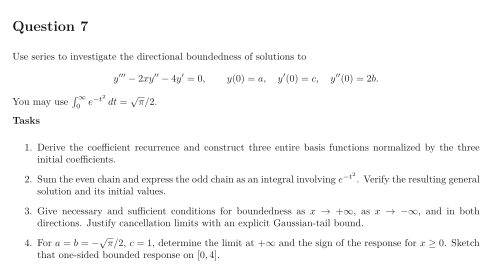
Use series to investigate the directional boundedness of solutions to You may use .
Tasks
Derive the coefficient recurrence and construct three entire basis functions normalized by the three initial coefficients.
Sum the even chain and express the odd chain as an integral involving . Verify the resulting general solution and its initial values.
Give necessary and sufficient conditions for boundedness as , as , and in both directions. Justify cancellation limits with an explicit Gaussian-tail bound.
For , , determine the limit at and the sign of the response for . Sketch that one-sided bounded response on .
Show solutionHide solution
Question 7 – Solution
Strategy. Build an entire basis from the recurrence, then examine its exponentially amplified coefficients at each end of the real line.
Step 1: Follow the even and odd chains. Matching gives for . The independent seeds are , , . Ratio tests along each chain give infinite radius. A normalized basis is
Step 2: Identify and verify the odd basis. The function satisfies ; differentiating twice proves the third-order equation and its initial triple . The other two basis functions also satisfy the equation. Thus Its initial coefficients are exactly in degrees zero, one and two.
Step 3: Classify both ends. Put . At , a nonzero forces exponential growth. If , the remaining tail tends to zero because, for , The inequality follows by replacing with in the integral. Therefore boundedness at is equivalent to , with limit . Oddness of the integral gives the condition at , also with limit . Both conditions hold exactly when , leaving constants.
Step 4: Check the selected response. Here for , and the tail estimate gives as .
See the diagram in the original worksheet below.
