Question 4
Near , consider The leading coefficient vanishes at , but this does not by itself prove that every solution is singular there.
Tasks
Derive the recurrence for the Taylor coefficients and sum the resulting series on .
Classify exactly which initial triples give analytic continuation through , through , and through both points.
Determine the Taylor radius at zero for every initial triple. Explain how an entire solution can coexist with singular coefficients in the normalized equation.
For the data , find the continued value and first two derivatives at . Verify the original equation at that point, and give the maximal real interval on which this solution is analytic.
Show solutionHide solution
Question 4 – Solution
Strategy. Sum the two coefficient tails, then check cancellation of each possible pole separately.
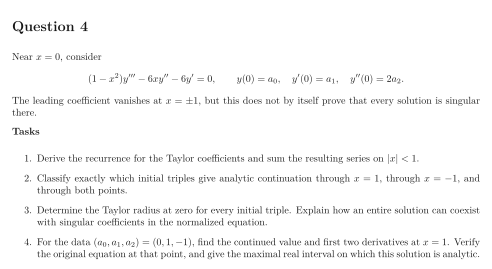
Step 1: Derive and sum the recurrence. The coefficient equation simplifies to Thus the odd tail repeats and the positive even tail repeats : As an independent check, the differential equation is exactly .
Step 2: Classify pole cancellation. The numerator of the fractional term vanishes at exactly when , and at exactly when . Because the denominator’s zeros are simple, these are also sufficient for analytic continuation through the respective point. Continuation through both requires , yielding the constant solution.
Step 3: Determine every convergence radius. If , the Taylor series is constant and its radius is infinite. Otherwise at least one genuine pole remains at distance one, so the radius is exactly one, even if the other pole cancels. Singularities of the normalized coefficients constrain the general theory; they need not be singularities of a particular solution after cancellation.
Step 4: Verify passage through a singular point. For the stated data, after cancellation. Therefore At , the original equation reduces to , which these values satisfy. The continued solution is analytic on , its maximal real analytic interval containing zero. Its Taylor series about zero still has radius one because the pole at remains.