Question 2
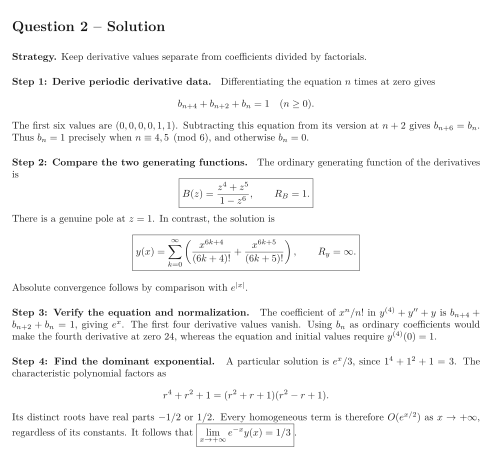
For the fourth-order problem let and . The ordinary generating function is not the solution’s Taylor series.
Tasks
Derive a recurrence for and prove that the derivative sequence is periodic. Give one full period.
Find and its radius of convergence. Write the actual solution series using and determine its radius separately.
Verify the differential equation directly from the solution series and explain why treating as ordinary Taylor coefficients would give a wrong answer.
Determine without explicitly solving for all homogeneous constants. Justify why the homogeneous contribution disappears in this limit.
Show solutionHide solution
Question 2 – Solution
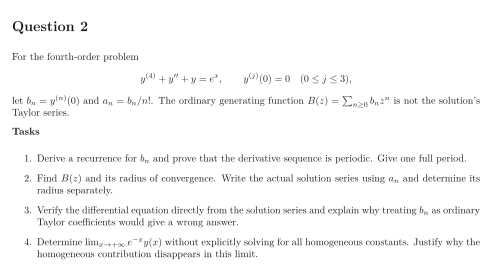
Strategy. Keep derivative values separate from coefficients divided by factorials.
Step 1: Derive periodic derivative data. Differentiating the equation times at zero gives The first six values are . Subtracting this equation from its version at gives . Thus precisely when , and otherwise .
Step 2: Compare the two generating functions. The ordinary generating function of the derivatives is There is a genuine pole at . In contrast, the solution is Absolute convergence follows by comparison with .
Step 3: Verify the equation and normalization. The coefficient of in is , giving . The first four derivative values vanish. Using as ordinary coefficients would make the fourth derivative at zero , whereas the equation and initial values require .
Step 4: Find the dominant exponential. A particular solution is , since . The characteristic polynomial factors as Its distinct roots have real parts or . Every homogeneous term is therefore as , regardless of its constants. It follows that .