Question 1
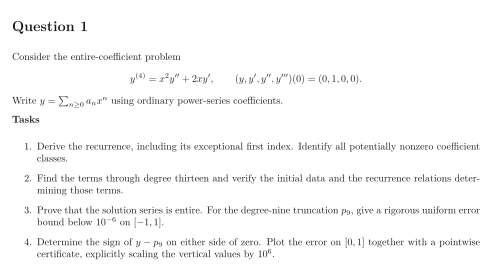
Consider the entire-coefficient problem Write using ordinary power-series coefficients.
Tasks
Derive the recurrence, including its exceptional first index. Identify all potentially nonzero coefficient classes.
Find the terms through degree thirteen and verify the initial data and the recurrence relations determining those terms.
Prove that the solution series is entire. For the degree-nine truncation , give a rigorous uniform error bound below on .
Determine the sign of on either side of zero. Plot the error on together with a pointwise certificate, explicitly scaling the vertical values by .
Show solutionHide solution
Question 1 – Solution
Strategy. Follow the surviving coefficient chain and bound its tail by a geometric majorant.
Step 1: Match every coefficient. The coefficient of on the right is , so In particular , not a freely chosen coefficient. The initial coefficients are ; only indices survive.
Step 2: Compute the first terms. Successive use of gives The missing coefficients are zero. The first four derivatives at zero match the data, and substitution into the recurrence verifies the displayed chain.
Step 3: Prove convergence and certify the tail. For fixed , successive nonzero terms have ratio in magnitude , so the series is entire and may be differentiated termwise. For , the coefficient ratio is at most . Consequently, for , This bound concerns the full infinite tail, not just its first omitted term.
Step 4: Check the error’s sign and graph. Every surviving coefficient is positive and every surviving degree is odd. Thus is positive for , negative for , and zero at zero. The figure compares and on .
See the diagram in the original worksheet below.
