Question 3
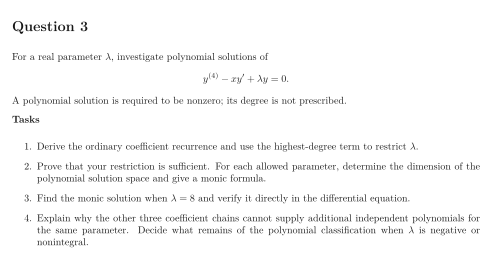
For a real parameter , investigate polynomial solutions of A polynomial solution is required to be nonzero; its degree is not prescribed.
Tasks
Derive the ordinary coefficient recurrence and use the highest-degree term to restrict .
Prove that your restriction is sufficient. For each allowed parameter, determine the dimension of the polynomial solution space and give a monic formula.
Find the monic solution when and verify it directly in the differential equation.
Explain why the other three coefficient chains cannot supply additional independent polynomials for the same parameter. Decide what remains of the polynomial classification when is negative or nonintegral.
Show solutionHide solution
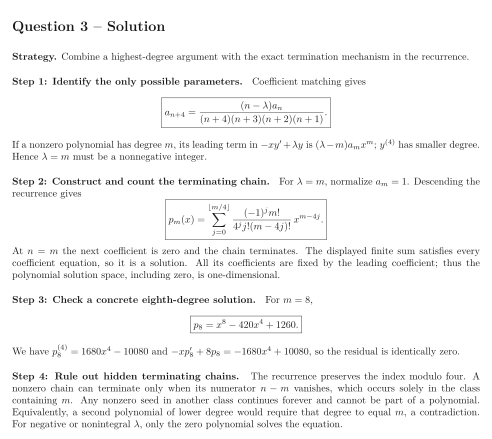
Question 3 – Solution
Strategy. Combine a highest-degree argument with the exact termination mechanism in the recurrence.
Step 1: Identify the only possible parameters. Coefficient matching gives If a nonzero polynomial has degree , its leading term in is ; has smaller degree. Hence must be a nonnegative integer.
Step 2: Construct and count the terminating chain. For , normalize . Descending the recurrence gives At the next coefficient is zero and the chain terminates. The displayed finite sum satisfies every coefficient equation, so it is a solution. All its coefficients are fixed by the leading coefficient; thus the polynomial solution space, including zero, is one-dimensional.
Step 3: Check a concrete eighth-degree solution. For , We have and , so the residual is identically zero.
Step 4: Rule out hidden terminating chains. The recurrence preserves the index modulo four. A nonzero chain can terminate only when its numerator vanishes, which occurs solely in the class containing . Any nonzero seed in another class continues forever and cannot be part of a polynomial. Equivalently, a second polynomial of lower degree would require that degree to equal , a contradiction. For negative or nonintegral , only the zero polynomial solves the equation.