Question 5
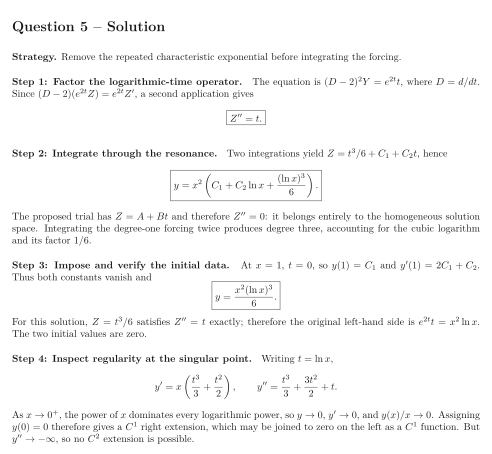
For , solve the resonantly forced Euler problem A trial expression resembles the forcing but may not produce it.
Tasks
Transform the equation using and then . Derive the resulting equation for .
Find the general solution. Explain exactly why the proposed trial expression fails and why a cubic logarithmic term appears.
Apply the initial conditions and verify the final solution by computing the transformed residual.
Determine whether the IVP solution extends continuously, as a function, or as a function to . Give the relevant limiting expressions.
Show solutionHide solution
Question 5 – Solution
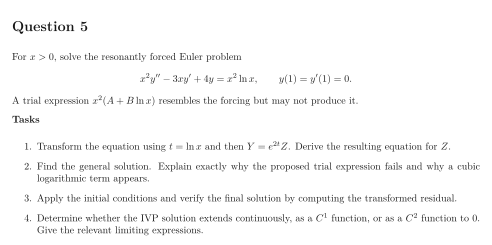
Strategy. Remove the repeated characteristic exponential before integrating the forcing.
Step 1: Factor the logarithmic-time operator. The equation is , where . Since , a second application gives
Step 2: Integrate through the resonance. Two integrations yield , hence The proposed trial has and therefore : it belongs entirely to the homogeneous solution space. Integrating the degree-one forcing twice produces degree three, accounting for the cubic logarithm and its factor .
Step 3: Impose and verify the initial data. At , , so and . Thus both constants vanish and For this solution, satisfies exactly; therefore the original left-hand side is . The two initial values are zero.
Step 4: Inspect regularity at the singular point. Writing , As , the power of dominates every logarithmic power, so , , and . Assigning therefore gives a right extension, which may be joined to zero on the left as a function. But , so no extension is possible.