Question 6
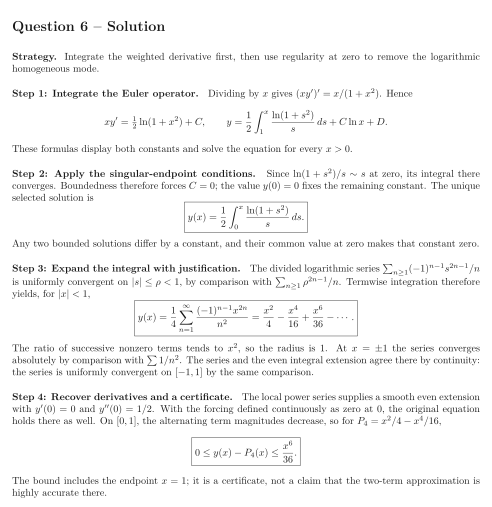
For , consider Instead of prescribing data at a positive point, seek the solution that is bounded near and extends continuously with .
Tasks
Integrate the equation to obtain its general solution in definite-integral form on , displaying both arbitrary constants.
Impose boundedness and the specified value at zero. Prove that they select exactly one solution on the positive half-line.
Derive its power series about zero, give its first three nonzero terms, and determine the radius and both endpoint outcomes. Justify termwise integration.
Prove that the selected solution has a extension to zero, compute and , and certify a two-term approximation on using a rigorous remainder bound.
Show solutionHide solution
Question 6 – Solution
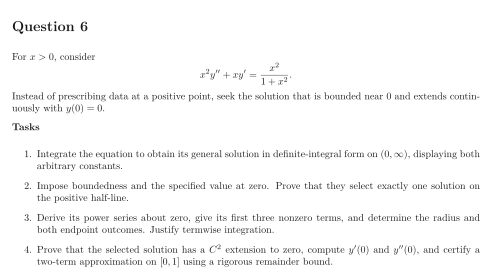
Strategy. Integrate the weighted derivative first, then use regularity at zero to remove the logarithmic homogeneous mode.
Step 1: Integrate the Euler operator. Dividing by gives . Hence These formulas display both constants and solve the equation for every .
Step 2: Apply the singular-endpoint conditions. Since at zero, its integral there converges. Boundedness therefore forces ; the value fixes the remaining constant. The unique selected solution is Any two bounded solutions differ by a constant, and their common value at zero makes that constant zero.
Step 3: Expand the integral with justification. The divided logarithmic series is uniformly convergent on , by comparison with . Termwise integration therefore yields, for , The ratio of successive nonzero terms tends to , so the radius is . At the series converges absolutely by comparison with . The series and the even integral extension agree there by continuity: the series is uniformly convergent on by the same comparison.
Step 4: Recover derivatives and a certificate. The local power series supplies a smooth even extension with and . With the forcing defined continuously as zero at , the original equation holds there as well. On , the alternating term magnitudes decrease, so for , The bound includes the endpoint ; it is a certificate, not a claim that the two-term approximation is highly accurate there.