Question 4
Solve on the negative half-line: Using fractional powers without specifying a real branch can invalidate a solution.
Tasks
Use to derive a real fundamental pair on . Explain why the positive-half-line expression is unsuitable as a real-valued basis there.
Translate both initial values into logarithmic coordinates and solve the IVP. Check the derivative sign directly in the original variable.
Give its maximal real interval and both endpoint behaviors.
Find its unique stationary point and minimum. Explain how increasing logarithmic time relates to increasing on this negative interval.
Show solutionHide solution
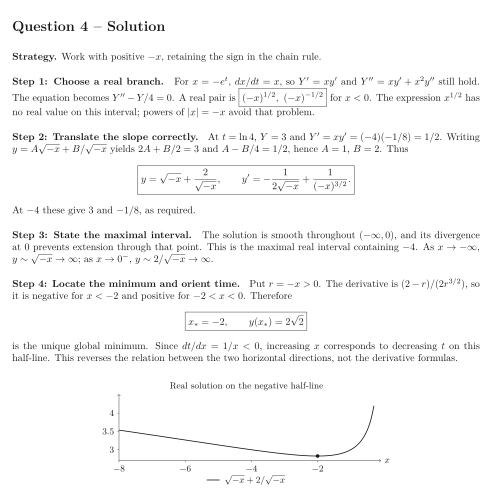
Question 4 – Solution
Strategy. Work with positive , retaining the sign in the chain rule.
Step 1: Choose a real branch. For , , so and still hold. The equation becomes . A real pair is for . The expression has no real value on this interval; powers of avoid that problem.
Step 2: Translate the slope correctly. At , and . Writing yields and , hence , . Thus At these give and , as required.
Step 3: State the maximal interval. The solution is smooth throughout , and its divergence at prevents extension through that point. This is the maximal real interval containing . As , ; as , .
Step 4: Locate the minimum and orient time. Put . The derivative is , so it is negative for and positive for . Therefore is the unique global minimum. Since , increasing corresponds to decreasing on this half-line. This reverses the relation between the two horizontal directions, not the derivative formulas.
See the diagram in the original worksheet below.