Question 3
Study the logarithmically oscillating IVP Oscillations in behave differently from oscillations in .
Tasks
Find the real general solution and the specified IVP solution.
Determine all its positive zeros and the ratio of consecutive zeros in increasing order. Explain where the zeros accumulate.
Decide whether the IVP solution is bounded near and whether it has a continuous extension there. Extend the conclusion about limits to every nonzero real solution of this equation.
Set . Determine the curve traced by and its direction as increases. Locate the initial point and distinguish this curve from the graph of against .
Show solutionHide solution
Question 3 – Solution
Strategy. Use to reveal a harmonic oscillator and then translate its time scale back to .
Step 1: Solve the transformed oscillator. The transformed equation is , so . At , and , hence The characteristic exponents are .
Step 2: Locate the geometric sequence of zeros. Zeros occur when : They accumulate at as and grow without bound as . There is no smallest positive zero.
Step 3: Separate boundedness from a limit. The IVP solution has , but sequences with and tend to while giving values and . Thus no limit at zero exists. Any nonzero real solution is a nonzero-amplitude sinusoid in and likewise attains two distinct limiting values along sequences approaching zero. Only the zero solution extends continuously there.
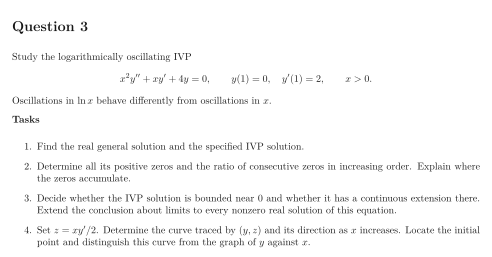
Step 4: Read the scaled phase curve. For the IVP, , so . In logarithmic time, , ; at the motion is to the right. The circle is traversed clockwise as increases, because increases with . The horizontal coordinate here is , not ; equal scales preserve the unit circle.
See the diagram in the original worksheet below.