Question 5
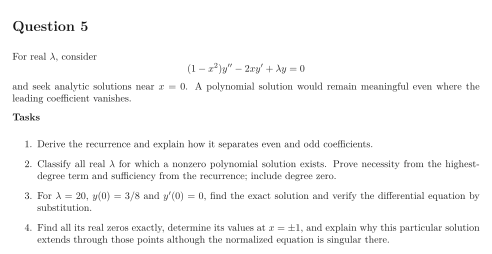
For real , consider and seek analytic solutions near . A polynomial solution would remain meaningful even where the leading coefficient vanishes.
Tasks
Derive the recurrence and explain how it separates even and odd coefficients.
Classify all real for which a nonzero polynomial solution exists. Prove necessity from the highest-degree term and sufficiency from the recurrence; include degree zero.
For , and , find the exact solution and verify the differential equation by substitution.
Find all its real zeros exactly, determine its values at , and explain why this particular solution extends through those points although the normalized equation is singular there.
Show solutionHide solution
Question 5 – Solution
Strategy. Use coefficient termination to distinguish polynomial solutions from general local series.
Step 1: Derive the parity recurrence. Matching gives Even and odd indices evolve independently from and .
Step 2: Characterize termination completely. If a nonzero polynomial has degree , its highest coefficient obeys , so for an integer . Conversely, choose the starting coefficient of parity nonzero and the other zero. For indices of that parity below , no numerator vanishes; at it does, terminating the chain. Thus these and only these parameter values work, including , (constants).
Step 3: Construct and verify the requested polynomial. For , the recurrence yields , , and . Hence Here and . Substitution in cancels every coefficient. Initial data also hold, so uniqueness near identifies the solution.
Step 4: Locate roots and extend the solution. Solving the quadratic in gives four distinct zeros: They lie in , and . The polynomial satisfies the original equation identically for every real , including . Singular normalized coefficients do not forbid this special solution from extending through them.
See the diagram in the original worksheet below.
