Question 4
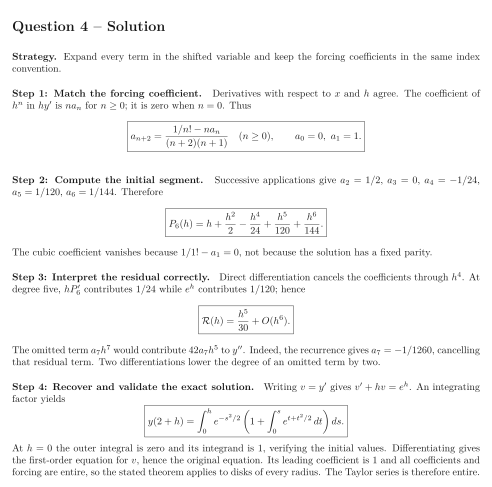
Consider a nonhomogeneous equation centered away from the origin: You may use the analytic ordinary-point theorem: a linear equation with nonzero leading coefficient and analytic normalized coefficients and forcing in a complex disk has a convergent Taylor solution throughout that disk.
Tasks
Set and derive the recurrence for , explicitly accounting for the constant coefficient of .
Compute through and the resulting polynomial . Identify any coefficient that vanishes despite nonzero neighboring coefficients.
Define the residual . Find its leading nonzero term. Explain why a degree-six solution truncation need not satisfy the differential equation through degree six.
Produce a definite-integral representation of the exact solution and justify infinite radius of convergence for its series. Check both initial values in your representation.
Show solutionHide solution
Question 4 – Solution
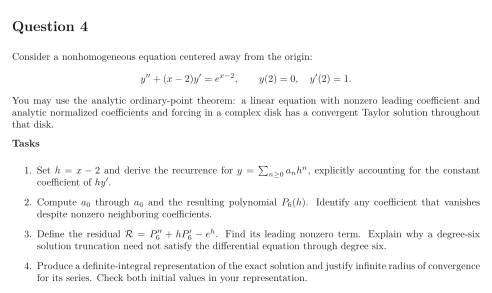
Strategy. Expand every term in the shifted variable and keep the forcing coefficients in the same index convention.
Step 1: Match the forcing coefficient. Derivatives with respect to and agree. The coefficient of in is for ; it is zero when . Thus
Step 2: Compute the initial segment. Successive applications give , , , , . Therefore The cubic coefficient vanishes because , not because the solution has a fixed parity.
Step 3: Interpret the residual correctly. Direct differentiation cancels the coefficients through . At degree five, contributes while contributes ; hence The omitted term would contribute to . Indeed, the recurrence gives , cancelling that residual term. Two differentiations lower the degree of an omitted term by two.
Step 4: Recover and validate the exact solution. Writing gives . An integrating factor yields At the outer integral is zero and its integrand is , verifying the initial values. Differentiating gives the first-order equation for , hence the original equation. Its leading coefficient is and all coefficients and forcing are entire, so the stated theorem applies to disks of every radius. The Taylor series is therefore entire.