Question 6
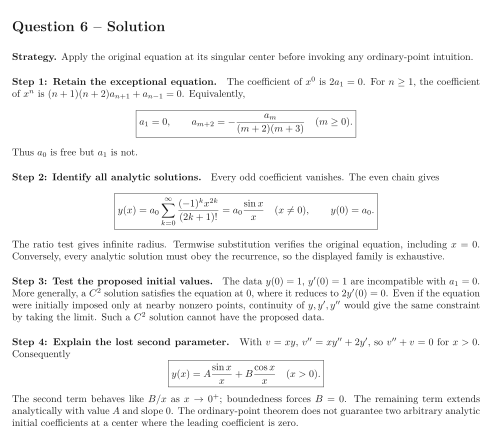
The leading coefficient vanishes at the proposed expansion center in A student therefore needs to check which initial data a Maclaurin solution can actually accommodate.
Tasks
Substitute . Find the exceptional constant-coefficient equation and the recurrence for all remaining coefficients.
Determine every analytic solution near and identify its series in terms of a familiar function, including the value assigned at .
Decide whether , can be satisfied by an analytic solution or even by a twice continuously differentiable solution of the original equation near .
On , substitute to find the full two-parameter solution. Determine which members extend boundedly to and explain why only one free parameter survives in the analytic family.
Show solutionHide solution
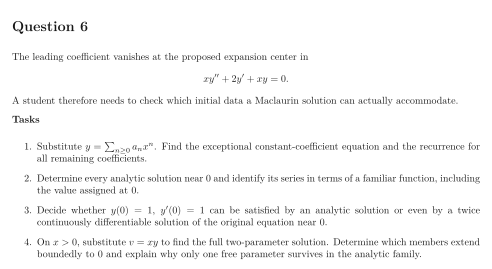
Question 6 – Solution
Strategy. Apply the original equation at its singular center before invoking any ordinary-point intuition.
Step 1: Retain the exceptional equation. The coefficient of is . For , the coefficient of is . Equivalently, Thus is free but is not.
Step 2: Identify all analytic solutions. Every odd coefficient vanishes. The even chain gives The ratio test gives infinite radius. Termwise substitution verifies the original equation, including . Conversely, every analytic solution must obey the recurrence, so the displayed family is exhaustive.
Step 3: Test the proposed initial values. The data , are incompatible with . More generally, a solution satisfies the equation at , where it reduces to . Even if the equation were initially imposed only at nearby nonzero points, continuity of would give the same constraint by taking the limit. Such a solution cannot have the proposed data.
Step 4: Explain the lost second parameter. With , , so for . Consequently The second term behaves like as ; boundedness forces . The remaining term extends analytically with value and slope . The ordinary-point theorem does not guarantee two arbitrary analytic initial coefficients at a center where the leading coefficient is zero.