Question 9
For , , focus on the strip and its boundaries. You may use and on this strip.
Tasks
Find the equilibria and verify the trajectory , including its direction and its limits as .
Explain why the closed segment joining the two equilibria is not a single trajectory, even though it is the closure of the connecting orbit.
For initial state , find a parametrization and eliminate time on the strip. Describe the forward and backward limits, treating separately.
Determine trajectories on and . Can a nonconstant one reach its equilibrium in finite time? Distinguish approaching an endpoint from attaining it.
Show solutionHide solution
Question 9 – Solution
Strategy. Keep equilibria separate from nearby nonconstant orbits, and retain the open domain when eliminating time.
Step 1: Identify the connecting trajectory. The equilibria are . The function solves both equations, has , and tends to backward in time and forward in time. Its orbit is the open horizontal segment , directed rightward.
Step 2: Separate the orbit from its closure. For every finite , , so neither endpoint is reached. Each endpoint is its own constant trajectory. Uniqueness for the smooth field also prevents a solution from reaching an equilibrium and then leaving it. The closed segment is the union of three trajectories, not one.
Step 3: Recover the whole one-parameter family. For initial , The inverse hyperbolic tangent formula proves the eliminated equation. Every member tends to as . If , the backward limit is . If , then while for or for ; there is no finite backward limiting state.
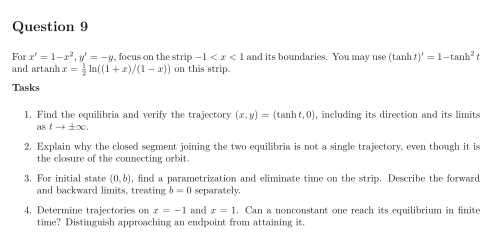
Step 4: Check the invariant boundary lines. On either , the first coordinate stays fixed and . For , each vertical half-line is an orbit directed toward , reached only as . At the state is already the equilibrium. The figure marks equilibria as separate filled points; connecting arrows and nearby trajectories approach them without asserting finite-time arrival.
See the diagram in the original worksheet below.