Question 8
Start with , , and introduce the nonlinear change of coordinates , . The original unit-circle trajectory is . Both coordinate planes should be drawn with equal scales when interpreting their geometry.
Tasks
Find the inverse coordinate change and derive the autonomous system for .
Find the image of the unit circle as an implicit equation and a time parametrization. Verify the parametrization in the transformed differential equations.
Determine the equilibrium, the least positive period of the transformed unit orbit, and its velocity at the image of .
Can this invertible coordinate change turn the unit circle into a self-intersecting trajectory? Prove your conclusion and explain which geometric features can change even though the time parametrization is preserved.
Show solutionHide solution
Question 8 – Solution
Strategy. Transform both the curve and its velocity by the chain rule; invertibility preserves distinct states even when shapes change.
Step 1: Derive the inverse and new field. The inverse is , , valid on the whole plane. Therefore The term in is essential. This is a nonlinear autonomous system, despite the linear original field.
Step 2: Transform and verify the orbit. Substituting into gives Here , and . Thus this is the actual transformed trajectory, not merely a guessed level curve.
Step 3: Check equilibrium, period and orientation locally. From we have ; then forces . The only equilibrium is the image of the original origin. The transformed orbit has period . A smaller period would, through the inverse map, give a smaller period of , which is impossible. The image of is , with velocity : upward.
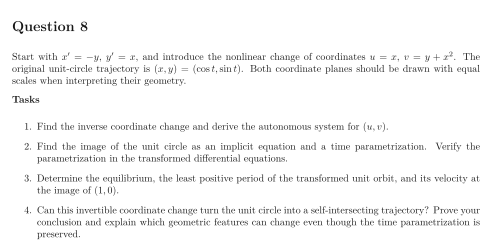
Step 4: Exclude a self-intersection. If two transformed states agree, the inverse gives equal original states. On the unit circle this occurs only for times differing by an integer multiple of . No new self-intersection can appear within one traversal. The circle becomes a distorted closed curve, so Euclidean lengths, angles and curvature can change. The same time variable and invertible state map preserve the period and prevent distinct states from being identified. The figure plots the transformed orbit in equal scales.
See the diagram in the original worksheet below.