Question 10
On the positive quadrant , , consider You may use the elementary geometric fact that a compact regular level of a smooth strictly convex function in the plane, enclosing its unique minimum, is a simple closed curve.
Tasks
Find the positive equilibrium and nullclines. Determine the velocity and direction at the stated initial point.
Prove that is conserved, and find its level for the initial data.
Use convexity, boundary behavior and the vector field to show that this nonconstant orbit is closed and traversed in a finite period. No period formula is required.
Find exact equations for the minimum and maximum of each population on this orbit, identify where those extrema occur, and explain why their maxima are not simultaneous.
Show solutionHide solution
Question 10 – Solution
Strategy. A proper conserved function confines the positive orbit, and nonzero tangential velocity turns its level curve into a periodic trajectory.
Step 1: Read the positive nullclines. In the positive quadrant, exactly at , and exactly at . The only positive equilibrium is . At the velocity is , so the orbit initially moves upward. The positive axes are not included in the stated domain.
Step 2: Derive the conserved level. Differentiating yields For the stated data, . The Hessian is diagonal with entries , so is strictly convex with unique minimum .
Step 3: Justify a closed periodic orbit. The function tends to infinity as or . Thus this level is compact within the positive quadrant. Its gradient vanishes only at , below the stated level; it is regular. The given convex-level fact makes it a simple closed curve. The vector field is tangent by conservation and never zero on this curve. Its continuous speed therefore has a positive minimum, so traversal of the finite-length smooth closed curve takes finite time. Uniqueness then gives a periodic orbit. It is counterclockwise, as its velocity at the rightmost point is upward.
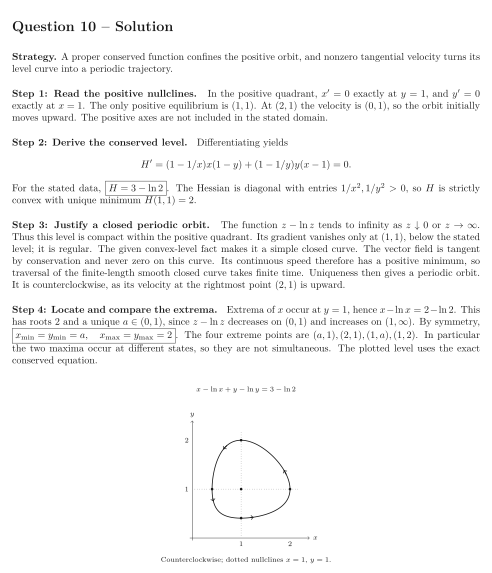
Step 4: Locate and compare the extrema. Extrema of occur at , hence . This has roots and a unique , since decreases on and increases on . By symmetry, . The four extreme points are . In particular the two maxima occur at different states, so they are not simultaneous. The plotted level uses the exact conserved equation.
See the diagram in the original worksheet below.