Question 4
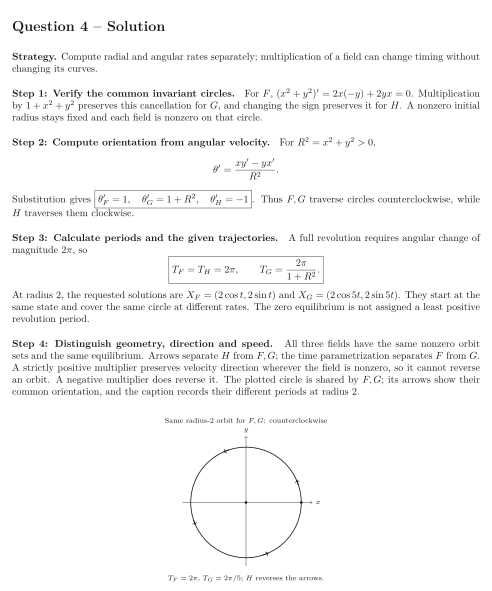
Compare the autonomous vector fields All three have the origin as an equilibrium. A geometric orbit and the time needed to traverse it are different pieces of information.
Tasks
Prove that every nonzero trajectory of each field lies on a circle centered at the origin.
On a circle of radius , compute the angular velocity for each field and determine its time direction.
Find the least positive period on that circle for each field. Give explicit solutions starting at for and .
Explain precisely which information is shared by the three phase pictures and which requires arrows or time parametrization. Does a positive scalar multiple of a field reverse its directions?
Show solutionHide solution
Question 4 – Solution
Strategy. Compute radial and angular rates separately; multiplication of a field can change timing without changing its curves.
Step 1: Verify the common invariant circles. For , . Multiplication by preserves this cancellation for , and changing the sign preserves it for . A nonzero initial radius stays fixed and each field is nonzero on that circle.
Step 2: Compute orientation from angular velocity. For , Substitution gives . Thus traverse circles counterclockwise, while traverses them clockwise.
Step 3: Calculate periods and the given trajectories. A full revolution requires angular change of magnitude , so At radius , the requested solutions are and . They start at the same state and cover the same circle at different rates. The zero equilibrium is not assigned a least positive revolution period.
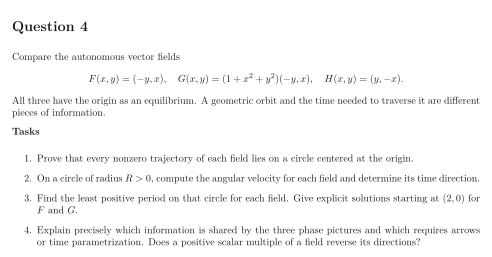
Step 4: Distinguish geometry, direction and speed. All three fields have the same nonzero orbit sets and the same equilibrium. Arrows separate from ; the time parametrization separates from . A strictly positive multiplier preserves velocity direction wherever the field is nonzero, so it cannot reverse an orbit. A negative multiplier does reverse it. The plotted circle is shared by ; its arrows show their common orientation, and the caption records their different periods at radius .
See the diagram in the original worksheet below.