Question 3
Consider the autonomous nonlinear system A nullcline describes a zero coordinate velocity. It need not be a trajectory. No explicit solution of the full system is required.
Tasks
Find the equilibrium and both nullclines.
Use inequalities relative to the nullclines to determine the signs of in every region. Give the actual velocity at , and .
Determine tangent directions along each nullcline away from the equilibrium. Prove that neither whole nullcline is an invariant trajectory.
For a solution starting at , calculate . Explain how it can have a vertical tangent while immediately leaving the -nullcline.
Show solutionHide solution
Question 3 – Solution
Strategy. Read component signs from the two defining expressions, then distinguish instantaneous tangency from remaining on a curve.
Step 1: Locate the nullclines and their intersection. The -nullcline is , and the -nullcline is . Their sole intersection is the equilibrium .
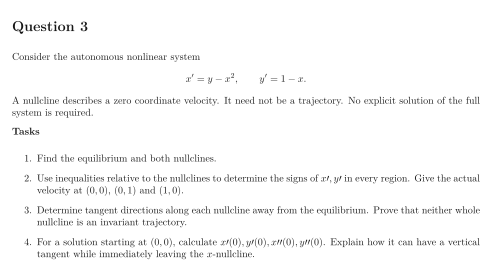
Step 2: Determine the regional directions. Above the parabola ; below it . To the left of , ; to its right, . Combining these independent signs gives right/up, left/up, right/down or left/down wherever the corresponding inequalities hold. The requested velocities are , and .
Step 3: Check nullcline tangency correctly. On , away from , the nonzero velocity is vertical. The parabola has finite-slope tangent , so this velocity is not tangent to that parabola. On , away from the equilibrium, the velocity is horizontal and not tangent to the vertical line. Thus neither complete nullcline is invariant. Each is crossed by typical solutions; the equilibrium is the exception where both velocities vanish.
Step 4: Examine departure from the origin. Differentiating the equations gives and . At the initial state, Hence and as . For small positive , , so the solution leaves the nullcline and acquires positive horizontal velocity. A vertical tangent at one instant does not mean that stays constant. The figure shows nullclines and local velocity arrows, not guessed solution curves.
See the diagram in the original worksheet below.