Question 5
The time-dependent system , has two proposed solutions Investigate whether their projected curves in the plane can cross without contradicting uniqueness of the original initial-value problem.
Tasks
Verify the candidates, derive the full solution family, and find the equations of their two projected curves.
Find the intersection of those curves, the time at which each solution visits it, and the velocity of each at its visit.
Decide whether and ever agree at the same time. Explain why the usual no-crossing conclusion for a locally Lipschitz autonomous plane field does not apply to these projections.
Add time as a state to obtain an autonomous three-dimensional system. Show that the two lifted trajectories do not intersect, including above their projected intersection.
Show solutionHide solution
Question 5 – Solution
Strategy. Record the time attached to each projected point; the vector field here is not determined by the plane coordinates alone.
Step 1: Verify and eliminate time. Both derivatives are , so both candidates solve the system. Integration gives the full family . The candidate plane curves are respectively and , each directed toward increasing .
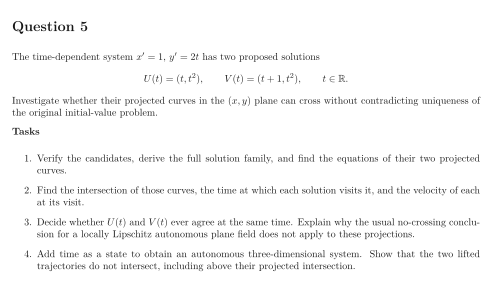
Step 2: Locate the projected crossing and its times. Solving gives . The first solution reaches it at , with velocity ; the second reaches it at , with velocity . The different tangent directions reflect different evaluation times.
Step 3: Check what uniqueness prohibits. At any common time, , so the full states never agree. The IVP is unique, but the projected point alone does not fix . There is no single autonomous plane velocity at the projected crossing. Thus the autonomous no-crossing rule is inapplicable. Geometric intersection at different times is not an intersection of these solutions at the same specified time and state.
Step 4: Restore the clock in the state. With new independent variable , use The lifted candidates are and . An intersection of lifted curves would first require equal , hence equal , and would then contradict the fixed horizontal difference . Above the plane crossing their clock coordinates are and , so the lifted states are distinct. The figure deliberately labels only projected plane curves and shows their separate rightward directions.
See the diagram in the original worksheet below.