Question 2
For , , a student divides the equations to obtain and concludes that every trajectory is a hyperbola . Investigate both the usefulness and the limitations of this calculation.
Tasks
Derive the conserved quantity without dividing by or . Find all equilibria.
Classify the trajectories lying on the coordinate axes, including their time directions. Explain what division can omit.
For , identify the separate trajectory branches and their directions in all four quadrants. Explain why an entire two-branch hyperbola is not one trajectory.
Solve the IVP and describe both time limits. Determine all initial states whose solutions tend to the origin as .
Show solutionHide solution
Question 2 – Solution
Strategy. Keep zero-coordinate cases before separating variables, and use explicit signs to orient each connected branch.
Step 1: Find a division-free invariant. The product rule gives . Thus along every solution, including axis solutions. The only equilibrium is .
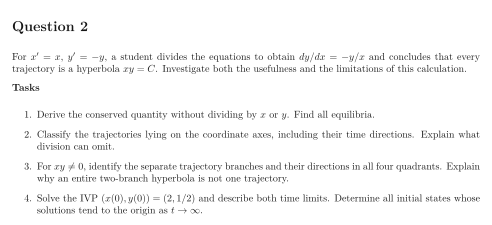
Step 2: Recover the axis trajectories. If , then ; each nonzero horizontal half-axis is a trajectory directed away from the origin. If , then ; each nonzero vertical half-axis is directed toward the origin. The origin itself is a constant trajectory. Division by loses the vertical axis; subsequent division by can also lose the horizontal axis.
Step 3: Separate the hyperbola branches. For nonzero coordinates, and preserve both signs. In quadrants I, II, III, IV the directions are respectively right/down, left/down, left/up, right/up. Each fixed nonzero has two disconnected branches; no continuous solution switches between them. The equation likewise combines several distinct trajectories rather than describing one orbit through the origin.
Step 4: Apply the initial data and characterize attraction. For the stated IVP, As , , ; as , , . Neither limit is the origin. For general initial data, convergence to the origin in forward time occurs exactly when , including the zero state. The figure distinguishes the axis directions from representative hyperbola branches.
See the diagram in the original worksheet below.