Question 9
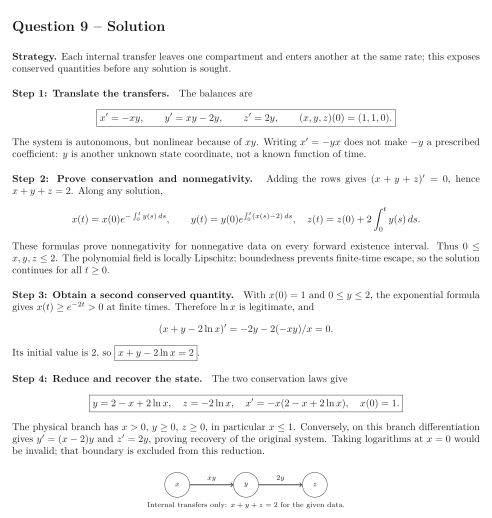
Three nonnegative dimensionless amounts undergo internal transfers: amount moves from compartment to at rate , and from to at rate . There are no external gains or losses. Their initial amounts are . The rate laws are valid for nonnegative states.
Tasks
Derive the vector differential equation and classify it as autonomous and linear or nonlinear. Explain why a state-dependent coefficient does not make this a linear system.
Find the total-amount balance. Show that nonnegative initial states remain nonnegative and use this to bound every component for the stated data.
For the stated initial data, prove at every finite forward time. Derive a second conserved expression involving and .
Use the two conserved expressions to reduce the dynamics to one scalar equation for , with formulas recovering . State the restrictions that make the reduction meaningful; no explicit solution is required.
Show solutionHide solution
Question 9 – Solution
Strategy. Each internal transfer leaves one compartment and enters another at the same rate; this exposes conserved quantities before any solution is sought.
Step 1: Translate the transfers. The balances are The system is autonomous, but nonlinear because of . Writing does not make a prescribed coefficient: is another unknown state coordinate, not a known function of time.
Step 2: Prove conservation and nonnegativity. Adding the rows gives , hence . Along any solution, These formulas prove nonnegativity for nonnegative data on every forward existence interval. Thus . The polynomial field is locally Lipschitz; boundedness prevents finite-time escape, so the solution continues for all .
Step 3: Obtain a second conserved quantity. With and , the exponential formula gives at finite times. Therefore is legitimate, and Its initial value is , so .
Step 4: Reduce and recover the state. The two conservation laws give The physical branch has , , , in particular . Conversely, on this branch differentiation gives and , proving recovery of the original system. Taking logarithms at would be invalid; that boundary is excluded from this reduction.
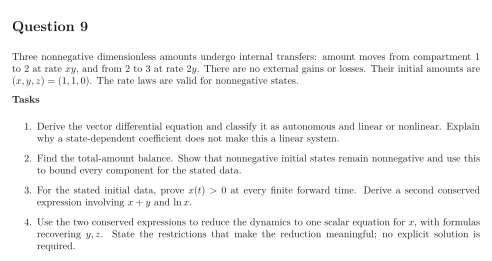
See the diagram in the original worksheet below.