Question 10
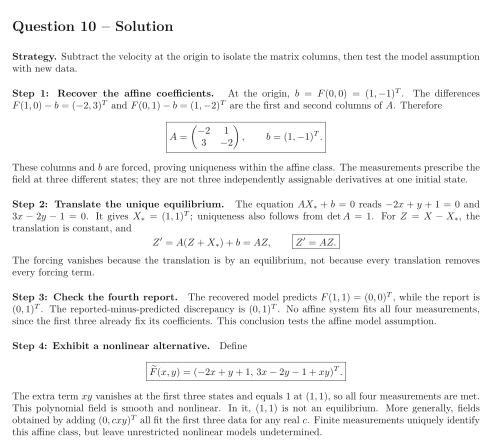
An unknown autonomous affine system has the form in , where are constant. Independent measurements of its velocity field give An affine system is written as a nonhomogeneous linear differential system; its constant forcing need not vanish.
Tasks
Recover and , and prove uniqueness within the class of affine systems. Explain why the measured inputs are states rather than initial derivatives of a single trajectory.
Find every equilibrium and translate it to the origin. Write the differential equation in the translated state and explain what happens to the constant forcing.
A fourth measurement reports . Is it compatible with the first three under the affine assumption? Quantify the discrepancy.
Construct a smooth nonlinear vector field fitting all four measurements. Explain why the first three determine an affine model uniquely but do not determine an unrestricted vector field.
Show solutionHide solution
Question 10 – Solution
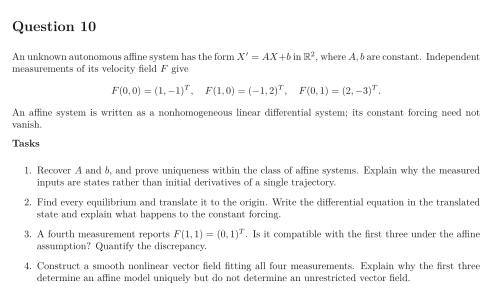
Strategy. Subtract the velocity at the origin to isolate the matrix columns, then test the model assumption with new data.
Step 1: Recover the affine coefficients. At the origin, . The differences and are the first and second columns of . Therefore These columns and are forced, proving uniqueness within the affine class. The measurements prescribe the field at three different states; they are not three independently assignable derivatives at one initial state.
Step 2: Translate the unique equilibrium. The equation reads and . It gives ; uniqueness also follows from . For , the translation is constant, and The forcing vanishes because the translation is by an equilibrium, not because every translation removes every forcing term.
Step 3: Check the fourth report. The recovered model predicts , while the report is . The reported-minus-predicted discrepancy is . No affine system fits all four measurements, since the first three already fix its coefficients. This conclusion tests the affine model assumption.
Step 4: Exhibit a nonlinear alternative. Define The extra term vanishes at the first three states and equals at , so all four measurements are met. This polynomial field is smooth and nonlinear. In it, is not an equilibrium. More generally, fields obtained by adding all fit the first three data for any real . Finite measurements uniquely identify this affine class, but leave unrestricted nonlinear models undetermined.