Question 8
For , consider You may use the local uniqueness theorem: continuity of a vector field and local Lipschitz continuity in the state guarantee local uniqueness. Failure of its hypotheses alone does not prove nonuniqueness.
Tasks
Check continuity and test the local Lipschitz condition at states with . Explain exactly which uniqueness guarantee is unavailable.
For any waiting time , construct a solution that has until time and then becomes positive. Verify the derivative at the joining time as well as both differential equations.
Find and compare the initial state and initial derivative of the waiting-time solutions. Include the solution that never leaves .
If an additional observation says , does that restore uniqueness for later times? Exhibit two distinct solutions satisfying all the data and explain what this example says about a complete initial state.
Show solutionHide solution
Question 8 – Solution
Strategy. Prove nonuniqueness by constructing different differentiable solutions; do not infer it solely from a theorem’s failure.
Step 1: Test the regularity hypothesis. The field is continuous everywhere. For , the change in its first component between and , divided by the state distance, is . This is unbounded as , so no local Lipschitz constant exists near . The quoted uniqueness theorem cannot guarantee uniqueness there.
Step 2: Construct and check the waiting family. For each , define Before , both and are zero. After , both are . At , the left and right derivatives are zero, so the function is continuously differentiable and satisfies the equation there too. At , the same check uses the right derivative at the endpoint.
Step 3: Check the common data. The second scalar equation uniquely gives . Every pair has initial state and initial derivative . The pair is another solution, corresponding to waiting forever. Different finite waiting times produce different first components, despite identical initial states and slopes.
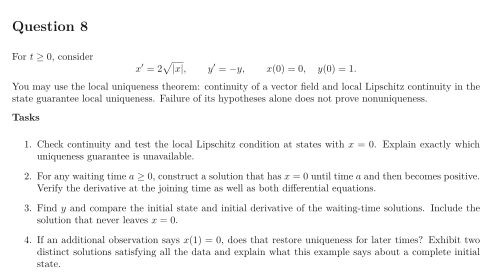
Step 4: Test whether one extra observation selects a solution. Every gives , as does the never-departing solution. For example, and satisfy all the data, but at their first components are and . Uniqueness is still absent. A complete state specifies all initial coordinates; unique evolution also requires appropriate properties of the differential equations. The figure shows three members of this family, with time increasing rightward.
See the diagram in the original worksheet below.