Question 7
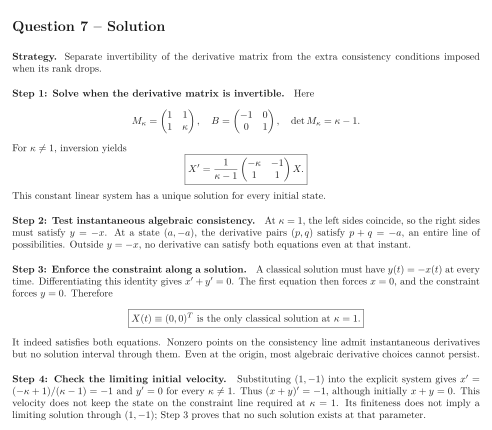
For a real constant , consider the implicit derivative equations A classical solution is a continuously differentiable pair satisfying both relations throughout an interval. An algebraically consistent derivative at one state is not necessarily part of a solution through that state.
Tasks
Write and determine exactly when it can be solved for a unique derivative at every state. Find the explicit system in that case.
At , determine the states at which the two equations are algebraically consistent for a derivative. Describe the possible derivatives at such a state.
Still at , find every classical solution on an interval of positive length. Explain why most instantaneously consistent states cannot be used as initial data.
For and initial state , compute the initial derivative and the derivative of . Does a finite, parameter-independent initial velocity imply that a solution exists through the same state at ?
Show solutionHide solution
Question 7 – Solution
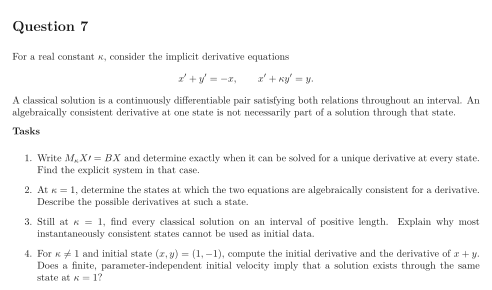
Strategy. Separate invertibility of the derivative matrix from the extra consistency conditions imposed when its rank drops.
Step 1: Solve when the derivative matrix is invertible. Here For , inversion yields This constant linear system has a unique solution for every initial state.
Step 2: Test instantaneous algebraic consistency. At , the left sides coincide, so the right sides must satisfy . At a state , the derivative pairs satisfy , an entire line of possibilities. Outside , no derivative can satisfy both equations even at that instant.
Step 3: Enforce the constraint along a solution. A classical solution must have at every time. Differentiating this identity gives . The first equation then forces , and the constraint forces . Therefore It indeed satisfies both equations. Nonzero points on the consistency line admit instantaneous derivatives but no solution interval through them. Even at the origin, most algebraic derivative choices cannot persist.
Step 4: Check the limiting initial velocity. Substituting into the explicit system gives and for every . Thus , although initially . This velocity does not keep the state on the constraint line required at . Its finiteness does not imply a limiting solution through ; Step 3 proves that no such solution exists at that parameter.