Question 4
An eigenpair satisfies with . The eigenspace includes zero, although zero is not an eigenvector. Algebraic multiplicity counts roots of ; geometric multiplicity is . Work over unless complex scalars are explicitly requested.
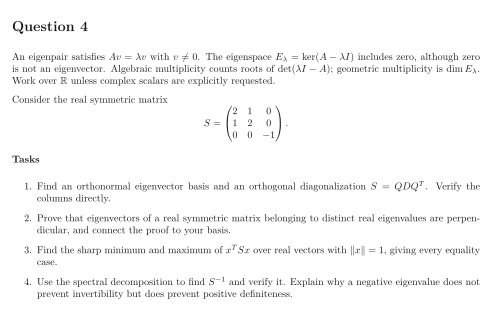
Consider the real symmetric matrix
Tasks
Find an orthonormal eigenvector basis and an orthogonal diagonalization . Verify the columns directly.
Prove that eigenvectors of a real symmetric matrix belonging to distinct real eigenvalues are perpendicular, and connect the proof to your basis.
Find the sharp minimum and maximum of over real vectors with , giving every equality case.
Use the spectral decomposition to find and verify it. Explain why a negative eigenvalue does not prevent invertibility but does prevent positive definiteness.
Show solutionHide solution
Question 4 – Solution
Strategy. An orthonormal eigenvector basis turns both a quadratic form and an inverse into scalar calculations.
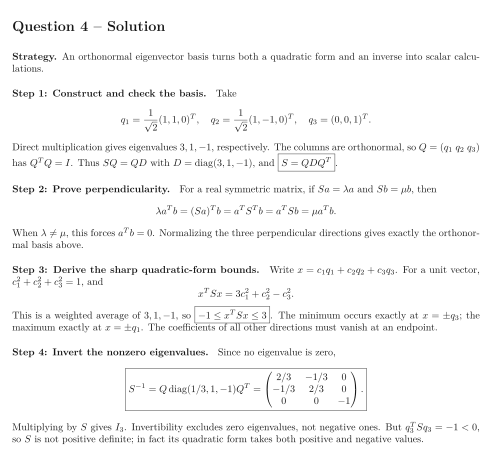
Step 1: Construct and check the basis. Take Direct multiplication gives eigenvalues , respectively. The columns are orthonormal, so has . Thus with , and .
Step 2: Prove perpendicularity. For a real symmetric matrix, if and , then When , this forces . Normalizing the three perpendicular directions gives exactly the orthonormal basis above.
Step 3: Derive the sharp quadratic-form bounds. Write . For a unit vector, , and This is a weighted average of , so . The minimum occurs exactly at ; the maximum exactly at . The coefficients of all other directions must vanish at an endpoint.
Step 4: Invert the nonzero eigenvalues. Since no eigenvalue is zero, Multiplying by gives . Invertibility excludes zero eigenvalues, not negative ones. But , so is not positive definite; in fact its quadratic form takes both positive and negative values.