Question 3
An eigenpair satisfies with . The eigenspace includes zero, although zero is not an eigenvector. Algebraic multiplicity counts roots of ; geometric multiplicity is . Work over unless complex scalars are explicitly requested.
Allow complex eigenvalues and eigenvectors for the real matrix Write , and let .
Tasks
Find both complex eigenvalues and their eigenspaces, and verify a representative eigenvector for each directly.
Prove that there is no nonzero real eigenvector, despite the existence of a complex eigenvector basis.
Write an eigenvector for as with real, and derive the two real equations obtained from its eigenvalue equation.
Express as a positive scale times a real rotation. Find and its length for every nonnegative integer , with the rotation angle specified unambiguously.
Show solutionHide solution
Question 3 – Solution
Strategy. Complex eigenvectors encode a real invariant plane; they need not describe a real line fixed in direction.
Step 1: Find and verify the complex pairs. The polynomial is , so Indeed . Conjugation verifies the other pair. The distinct eigenvalues give independent complex eigenvectors.
Step 2: Exclude a real eigenvector. If a real nonzero satisfied , a nonzero coordinate of would make the ratio of two real numbers. Thus would be real, but the characteristic polynomial has no real root. No such vector exists.
Step 3: Extract the real plane relations. For , take , . Equating real and imaginary parts of gives Direct multiplication verifies both. These independent real vectors span the plane even though neither is a real eigenvector.
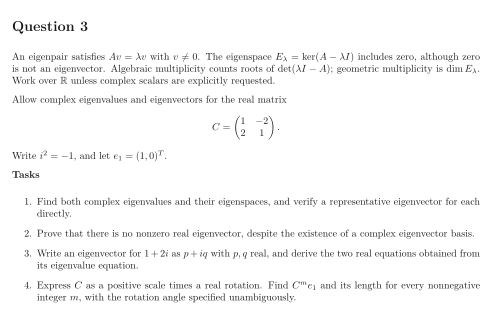
Step 4: Recover the rotation and scale. Let satisfy and ; equivalently . Then Its length is . The figure shows and its image , with unit and image circles drawn on equal scales.
See the diagram in the original worksheet below.