Question 5
An eigenpair satisfies with . The eigenspace includes zero, although zero is not an eigenvector. Algebraic multiplicity counts roots of ; geometric multiplicity is . Work over unless complex scalars are explicitly requested.
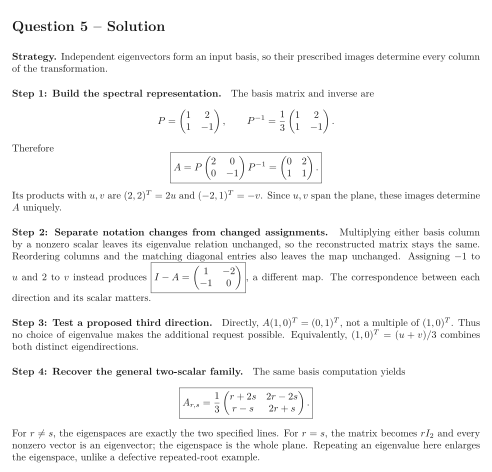
A real matrix is required to have
Tasks
Construct the unique matrix satisfying these specifications and verify both eigenpairs.
Explain the effect of rescaling the two eigenvectors or swapping their order together with the corresponding eigenvalues. Contrast this with assigning the eigenvalues to the opposite directions.
Can the same matrix also have as an eigenvector for some eigenvalue? Prove your answer.
Keeping the two prescribed directions, replace their eigenvalues by arbitrary real . Find the full matrix formula and explain how its eigenspaces change when .
Show solutionHide solution
Question 5 – Solution
Strategy. Independent eigenvectors form an input basis, so their prescribed images determine every column of the transformation.
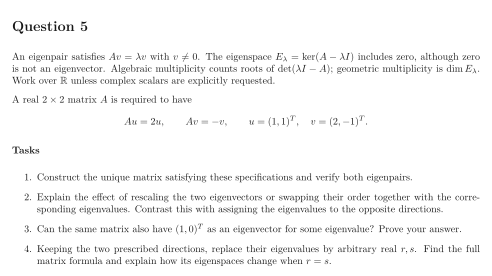
Step 1: Build the spectral representation. The basis matrix and inverse are Therefore Its products with are and . Since span the plane, these images determine uniquely.
Step 2: Separate notation changes from changed assignments. Multiplying either basis column by a nonzero scalar leaves its eigenvalue relation unchanged, so the reconstructed matrix stays the same. Reordering columns and the matching diagonal entries also leaves the map unchanged. Assigning to and to instead produces , a different map. The correspondence between each direction and its scalar matters.
Step 3: Test a proposed third direction. Directly, , not a multiple of . Thus no choice of eigenvalue makes the additional request possible. Equivalently, combines both distinct eigendirections.
Step 4: Recover the general two-scalar family. The same basis computation yields For , the eigenspaces are exactly the two specified lines. For , the matrix becomes and every nonzero vector is an eigenvector; the eigenspace is the whole plane. Repeating an eigenvalue here enlarges the eigenspace, unlike a defective repeated-root example.