Question 2
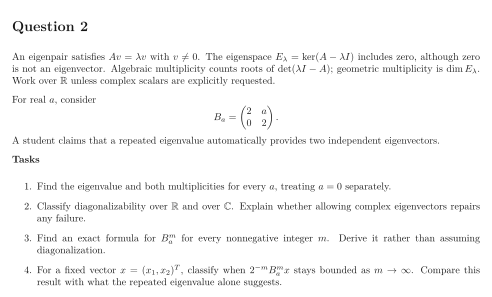
An eigenpair satisfies with . The eigenspace includes zero, although zero is not an eigenvector. Algebraic multiplicity counts roots of ; geometric multiplicity is . Work over unless complex scalars are explicitly requested.
For real , consider A student claims that a repeated eigenvalue automatically provides two independent eigenvectors.
Tasks
Find the eigenvalue and both multiplicities for every , treating separately.
Classify diagonalizability over and over . Explain whether allowing complex eigenvectors repairs any failure.
Find an exact formula for for every nonnegative integer . Derive it rather than assuming diagonalization.
For a fixed vector , classify when stays bounded as . Compare this result with what the repeated eigenvalue alone suggests.
Show solutionHide solution
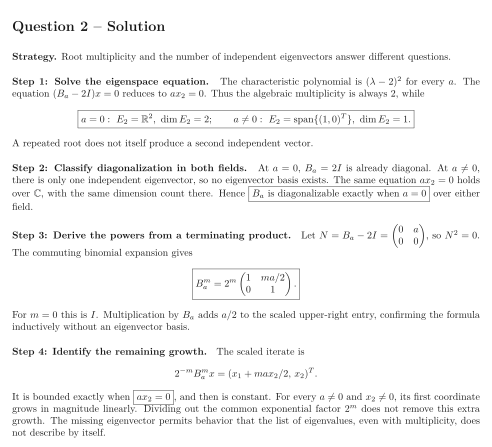
Question 2 – Solution
Strategy. Root multiplicity and the number of independent eigenvectors answer different questions.
Step 1: Solve the eigenspace equation. The characteristic polynomial is for every . The equation reduces to . Thus the algebraic multiplicity is always , while A repeated root does not itself produce a second independent vector.
Step 2: Classify diagonalization in both fields. At , is already diagonal. At , there is only one independent eigenvector, so no eigenvector basis exists. The same equation holds over , with the same dimension count there. Hence over either field.
Step 3: Derive the powers from a terminating product. Let , so . The commuting binomial expansion gives For this is . Multiplication by adds to the scaled upper-right entry, confirming the formula inductively without an eigenvector basis.
Step 4: Identify the remaining growth. The scaled iterate is It is bounded exactly when , and then is constant. For every and , its first coordinate grows in magnitude linearly. Dividing out the common exponential factor does not remove this extra growth. The missing eigenvector permits behavior that the list of eigenvalues, even with multiplicity, does not describe by itself.