Question 1
An eigenpair satisfies with . The eigenspace includes zero, although zero is not an eigenvector. Algebraic multiplicity counts roots of ; geometric multiplicity is . Work over unless complex scalars are explicitly requested.
Let and write a real starting vector as .
Tasks
Find the eigenvalues, their full eigenspaces and both multiplicities. Explain why arbitrary nonzero multiples of an eigenvector are allowed but the zero vector is not.
Express in the eigenvector basis and decide whether itself is an eigenvector.
Find for every nonnegative integer , and specialize to . Verify the result without multiplying out matrices.
For every nonzero real , determine the limit of . Include the cases , and .
Show solutionHide solution
Question 1 – Solution
Strategy. Resolve the starting vector into invariant directions before analyzing repeated multiplication.
Step 1: Compute the eigenspaces. The characteristic polynomial is . Solving the two singular systems gives Both algebraic and geometric multiplicities are . Scaling a nonzero eigenvector preserves its eigenvalue equation. Zero solves every homogeneous eigenvalue equation and supplies no direction, so it is excluded as an eigenvector.
Step 2: Decompose and test the given vector. The equations , give . Both components are nonzero and their eigenvalues differ. Directly, is not a scalar multiple of , so is not an eigenvector.
Step 3: Compute all iterates. Linearity and , give, by induction, The formula holds at , and one multiplication advances each coefficient by its eigenvalue, proving the next case.
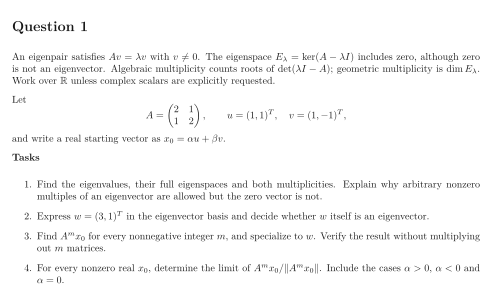
Step 4: Classify normalized direction limits. If , divide the iterate by before normalizing. The remaining coefficient tends to zero, so the limit is for and for . If , then and the iterate is the unchanged vector , giving limit . The dominant eigenvalue determines the limit only when its component is present. The diagram shows the two directions and the decomposition .
See the diagram in the original worksheet below.