Nonhomogeneous Systems — Question 4

PDF ↗

Question 4

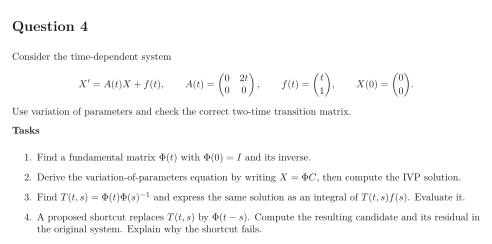
Consider the time-dependent system X′=A(t)X+f(t),A(t)=(02t00),f(t)=(t1),X(0)=(00).X'=A(t)X+f(t),\qquad A(t)=\begin{pmatrix}0&2t\\0&0\end{pmatrix},\qquad f(t)=\binom t1, \qquad X(0)=\binom 00. Use variation of parameters and check the correct two-time transition matrix.

Tasks

  1. Find a fundamental matrix Φ(t)\Phi(t) with Φ(0)=I\Phi(0)=I and its inverse.

  2. Derive the variation-of-parameters equation by writing X=ΦCX=\Phi C, then compute the IVP solution.

  3. Find T(t,s)=Φ(t)Φ(s)−1T(t,s)=\Phi(t)\Phi(s)^{-1} and express the same solution as an integral of T(t,s)f(s)T(t,s)f(s). Evaluate it.

  4. A proposed shortcut replaces T(t,s)T(t,s) by Φ(t−s)\Phi(t-s). Compute the resulting candidate and its residual in the original system. Explain why the shortcut fails.
Original worksheet page 1: question and worked solution for 5-10-004
Show solutionHide solution

Question 4 – Solution

Strategy. For time-dependent coefficients, propagation depends on both the departure time and the arrival time.

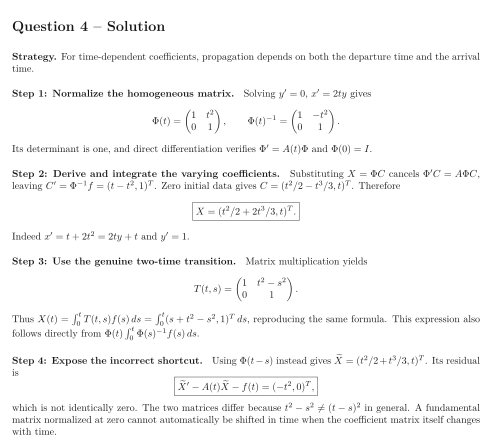
Step 1: Normalize the homogeneous matrix. Solving y′=0y'=0, x′=2tyx'=2ty gives Φ(t)=(1t201),Φ(t)−1=(1−t201).\Phi(t)=\begin{pmatrix}1&t^2\\0&1\end{pmatrix},\qquad \Phi(t)^{-1}=\begin{pmatrix}1&-t^2\\0&1\end{pmatrix}. Its determinant is one, and direct differentiation verifies Φ′=A(t)Φ\Phi'=A(t)\Phi and Φ(0)=I\Phi(0)=I.

Step 2: Derive and integrate the varying coefficients. Substituting X=ΦCX=\Phi C cancels Φ′C=AΦC\Phi'C=A\Phi C, leaving C′=Φ−1f=(t−t2,1)TC'=\Phi^{-1}f=(t-t^2,1)^T. Zero initial data gives C=(t2/2−t3/3,t)TC=(t^2/2-t^3/3,t)^T. Therefore X=(t2/2+2t3/3,t)T.\boxed{X=(t^2/2+2t^3/3,t)^T.} Indeed x′=t+2t2=2ty+tx'=t+2t^2=2ty+t and y′=1y'=1.

Step 3: Use the genuine two-time transition. Matrix multiplication yields T(t,s)=(1t2−s201).T(t,s)=\begin{pmatrix}1&t^2-s^2\\0&1\end{pmatrix}. Thus X(t)=∫0tT(t,s)f(s)ds=∫0t(s+t2−s2,1)TdsX(t)=\int_0^tT(t,s)f(s)\,ds =\int_0^t(s+t^2-s^2,1)^T\,ds, reproducing the same formula. This expression also follows directly from Φ(t)∫0tΦ(s)−1f(s)ds\Phi(t)\int_0^t\Phi(s)^{-1}f(s)\,ds.

Step 4: Expose the incorrect shortcut. Using Φ(t−s)\Phi(t-s) instead gives X̃=(t2/2+t3/3,t)T\widetilde X=(t^2/2+t^3/3,t)^T. Its residual is X̃′−A(t)X̃−f(t)=(−t2,0)T,\boxed{\widetilde X'-A(t)\widetilde X-f(t)=(-t^2,0)^T,} which is not identically zero. The two matrices differ because t2−s2≠(t−s)2t^2-s^2\ne(t-s)^2 in general. A fundamental matrix normalized at zero cannot automatically be shifted in time when the coefficient matrix itself changes with time.
Original worksheet page 2: question and worked solution for 5-10-004

Original worksheet layout. Use Enlarge or open the PDF for a closer view.