Question 3
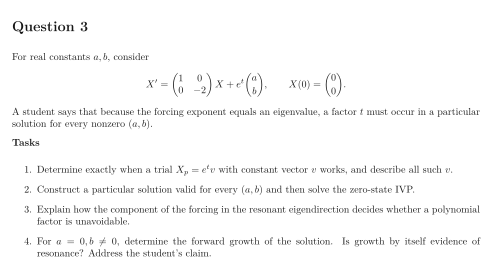
For real constants , consider A student says that because the forcing exponent equals an eigenvalue, a factor must occur in a particular solution for every nonzero .
Tasks
Determine exactly when a trial with constant vector works, and describe all such .
Construct a particular solution valid for every and then solve the zero-state IVP.
Explain how the component of the forcing in the resonant eigendirection decides whether a polynomial factor is unavoidable.
For , determine the forward growth of the solution. Is growth by itself evidence of resonance? Address the student’s claim.
Show solutionHide solution
Question 3 – Solution
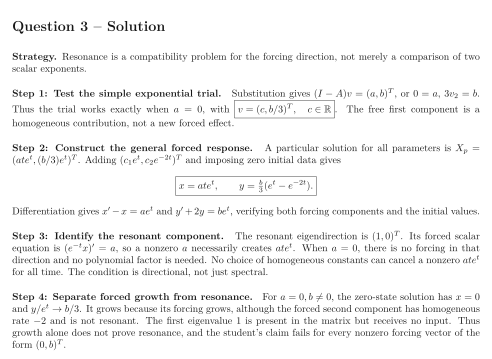
Strategy. Resonance is a compatibility problem for the forcing direction, not merely a comparison of two scalar exponents.
Step 1: Test the simple exponential trial. Substitution gives , or , . Thus the trial works exactly when , with . The free first component is a homogeneous contribution, not a new forced effect.
Step 2: Construct the general forced response. A particular solution for all parameters is . Adding and imposing zero initial data gives Differentiation gives and , verifying both forcing components and the initial values.
Step 3: Identify the resonant component. The resonant eigendirection is . Its forced scalar equation is , so a nonzero necessarily creates . When , there is no forcing in that direction and no polynomial factor is needed. No choice of homogeneous constants can cancel a nonzero for all time. The condition is directional, not just spectral.
Step 4: Separate forced growth from resonance. For , the zero-state solution has and . It grows because its forcing grows, although the forced second component has homogeneous rate and is not resonant. The first eigenvalue is present in the matrix but receives no input. Thus growth alone does not prove resonance, and the student’s claim fails for every nonzero forcing vector of the form .