Question 5
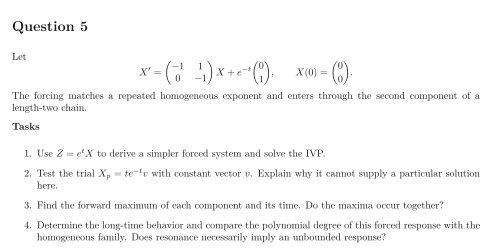
Let The forcing matches a repeated homogeneous exponent and enters through the second component of a length-two chain.
Tasks
Use to derive a simpler forced system and solve the IVP.
Test the trial with constant vector . Explain why it cannot supply a particular solution here.
Find the forward maximum of each component and its time. Do the maxima occur together?
Determine the long-time behavior and compare the polynomial degree of this forced response with the homogeneous family. Does resonance necessarily imply an unbounded response?
Show solutionHide solution
Question 5 – Solution
Strategy. Removing the common exponential reveals successive integrations along the nilpotent chain.
Step 1: Integrate along the chain. With , the transformed system is , . Thus , , giving , and Substitution verifies the original equation and zero initial state.
Step 2: Reject an insufficient polynomial trial. The trial would give , so its equation requires for every time. Matching coefficients forces and , but . These conditions contradict each other. A factor multiplying a constant vector is insufficient; the chain requires a quadratic term in the first component.
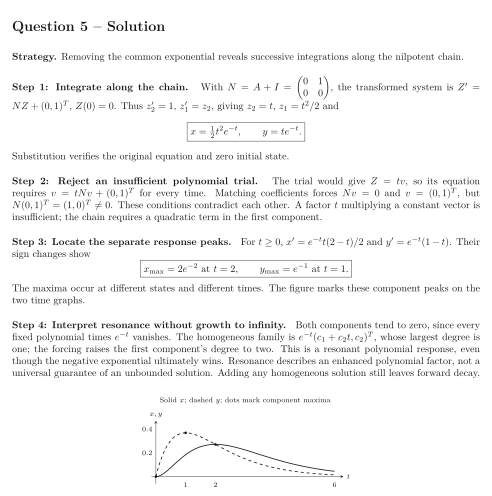
Step 3: Locate the separate response peaks. For , and . Their sign changes show The maxima occur at different states and different times. The figure marks these component peaks on the two time graphs.
Step 4: Interpret resonance without growth to infinity. Both components tend to zero, since every fixed polynomial times vanishes. The homogeneous family is , whose largest degree is one; the forcing raises the first component’s degree to two. This is a resonant polynomial response, even though the negative exponential ultimately wins. Resonance describes an enhanced polynomial factor, not a universal guarantee of an unbounded solution. Adding any homogeneous solution still leaves forward decay.
See the diagram in the original worksheet below.