Question 7
All functions are causal (zero for ). Use the one-sided Laplace transform and . Write for and for . Values at isolated endpoints do not affect an ordinary integral.
Let the unstable kernel be . First allow a piecewise continuous input supported in , where . Then specialize to with output .
Tasks
For the general input, derive a necessary and sufficient integral condition for the output to vanish for every .
For , compare the choice that makes the ordinary input area zero with the choice that eliminates the output tail.
For the tail-eliminating choice, derive the complete piecewise output and find its maximum.
Find the transformed output for general and compare its exact real transform domain before and after cancellation. Explain why the common transform domain of the factors need not be the output’s full domain.
Show solutionHide solution
Question 7 – Solution
Strategy. An unstable kernel remembers a weighted input area. Equal positive and negative ordinary areas need not cancel that memory.
Step 1: Factor the growing exponential. For an input supported in , Thus the output is zero for every if and only if , since never vanishes.
Step 2: Distinguish the two cancellations. The ordinary area is , so it vanishes at . The weighted area is ; its unique zero is . At it equals , leaving a growing tail.
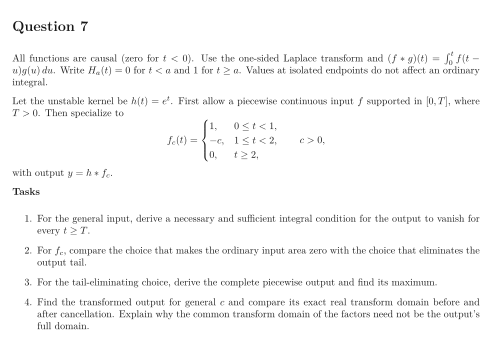
Step 3: Recover the selected response. Using the partial weighted integrals with gives The pieces agree at both junctions. It increases up to and decreases from to , so its unique maximum is at .
Step 4: Track the transform domain. The convolution theorem initially gives, for , If , the output has a nonzero tail and exact real domain . If , the output is compactly supported, so its transform exists for every real ; both apparent singularities at and are removable. The product formula agrees with it on and extends by removal of these singularities. Cancellation changes this output, not the unstable kernel. The dashed comparison uses , which cancels only the ordinary input area.
See the diagram in the original worksheet below.