Question 6
All functions are causal (zero for ). Use the one-sided Laplace transform and . Write for and for . Values at isolated endpoints do not affect an ordinary integral.
Three identical smoothing stages each have causal kernel , where . Their cascade has kernel .
Tasks
Compute the two-stage and three-stage kernels by direct integration.
Find the transform of and justify why the grouping of the convolutions does not matter.
Find the unique peak of , its height and its initial value and slope. Compare these with a single stage.
Compute the mass and mean time of both kernels. Explain what is preserved by cascading and what changes. You may derive needed exponential moments by integration by parts.
Show solutionHide solution
Question 6 – Solution
Strategy. Equal exponential factors leave polynomial integrals inside the convolution. Unit mass is preserved while the response is spread over time.
Step 1: Integrate the cascade. Directly,
Step 2: Check transforms and grouping. For real , . Both groupings integrate the same product over , . The continuous integrand is integrable on this bounded triangle, so reversing the integration order proves associativity directly.
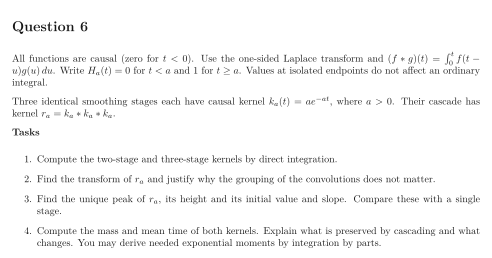
Step 3: Compare the peak and onset. For , . Thus the unique maximum is at , with height . Also . A single stage has maximum at zero and right derivative there. The cascade begins more smoothly, reaches its peak later and has a lower peak.
Step 4: Compute mass and mean time. Integration by parts yields for nonnegative integers . Hence Since both masses are one, these first moments are their mean times. The total area is preserved; the mean time triples. The cascade remains positive at every , so its later peak is not a literal waiting interval with zero output. The figure uses and the same vertical scale for both.
See the diagram in the original worksheet below.