Question 3
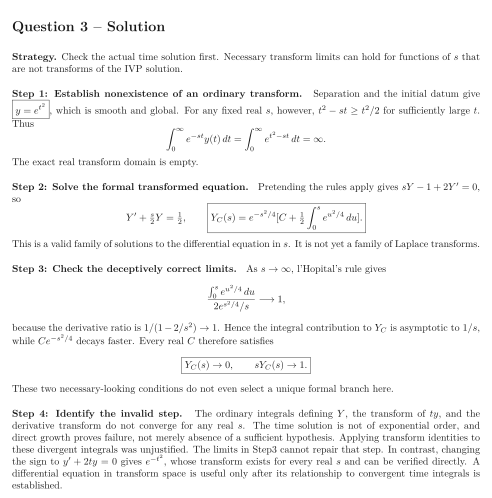
Use ordinary one-sided Laplace integrals for real . Where justified, write and use . Check existence and initial compatibility before treating a formal solution in as a transform.
Investigate the validity of the Laplace method for Do not assume that every global smooth IVP solution has an ordinary Laplace transform.
Tasks
Solve the time-domain IVP and determine whether its ordinary transform exists for any real .
Formally apply the transform rules and solve the resulting equation for a candidate , without yet claiming it is a transform.
Show that every member of this formal family satisfies and as .
Explain why neither those limits nor solving the formal equation validates the calculation. Identify the failed hypothesis and contrast it with the sign-reversed damping equation.
Show solutionHide solution
Question 3 – Solution
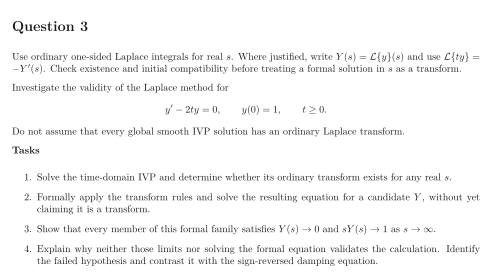
Strategy. Check the actual time solution first. Necessary transform limits can hold for functions of that are not transforms of the IVP solution.
Step 1: Establish nonexistence of an ordinary transform. Separation and the initial datum give , which is smooth and global. For any fixed real , however, for sufficiently large . Thus The exact real transform domain is empty.
Step 2: Solve the formal transformed equation. Pretending the rules apply gives , so This is a valid family of solutions to the differential equation in . It is not yet a family of Laplace transforms.
Step 3: Check the deceptively correct limits. As , l’Hopital’s rule gives because the derivative ratio is . Hence the integral contribution to is asymptotic to , while decays faster. Every real therefore satisfies These two necessary-looking conditions do not even select a unique formal branch here.
Step 4: Identify the invalid step. The ordinary integrals defining , the transform of , and the derivative transform do not converge for any real . The time solution is not of exponential order, and direct growth proves failure, not merely absence of a sufficient hypothesis. Applying transform identities to these divergent integrals was unjustified. The limits in Step3 cannot repair that step. In contrast, changing the sign to gives , whose transform exists for every real and can be verified directly. A differential equation in transform space is useful only after its relationship to convergent time integrals is established.